
The Border Crisis Quantified, Part 2
The past few years we’ve seen plenty of news about the mass influx of illegal immigrants entering the US largely unvetted, and reports about crime and human trafficking connected to the situation. Americans subsequently see immigration as a top issue in the 2024 election. What you may have heard less about, however, are the direct and indirect costs of this massive influx to the American citizen. This article distills information on these costs from several key sources with the aim of providing an inclusive and concise summary.
A study released in early 2023 by the Federation for American Immigration Reform (FAIR) is the most comprehensive available source of data on the direct costs to taxpayers. FAIR estimates that in fiscal year 2022, illegal immigration levied a net $150 billion burden on federal, state, and local governments.1
This reflects an estimated $182 billion in expenditures minus $32 billion in taxes contributed by those who lack citizenship or permanent residence status. Exhibit 1 below shows the total government costs, alien tax contributions and the divide between local and state (plus the burden on the taxpayer).
By comparison, the second costliest hurricane in U.S. history, Hurricane Harvey, is estimated to have cost the nation $160 billion.2 Perhaps, then, it would not be an overstatement to see the annual national cost of illegal migration as reaching catastrophic levels.
FAIR concludes that the average taxpayer paid $956 in fiscal year 2022 to compensate for alien migrants. In other words, because undocumented workers in large part do not pay income taxes, the American citizen taxpayer is obligated to foot the bill. FAIR also estimates that the annual net governmental cost of absorbing migrants had risen by $35 billion since 2017.
According to the FAIR report, the overall cost comprises government expenditures on medical care, law enforcement, education, and welfare assistance, also summarized in Exhibit 1. The report provides a methodical quantification of each of these categories, accompanied by an explanation of the assumptions required due to paucity of data. FAIR notes that the assumptions invoked are not worst case, so that actual costs may be higher than estimated.
FAIR’s estimates indeed do not appear overstated, considering that New York City alone, as of August 2023, was forecasting $3.6 billion in costs of caring for and accommodating its growing migrant population. As of that month, New York City was home to about 57,000 migrants, a small fraction of the national total, and this forecast is for just the cost borne by the city, exclusive of federal and state shares.3
Exhibit 1: Alien Net Burden on Taxpayers in Fiscal Year 2022
Total Federal Expenditures + Total State + Local Expenditures = Total National Expenditures
$66,449,136,000…………………………$115,608,730,000………………………$182,057,865,000
Total Federal Taxes Paid + Total State & Local Taxes Paid = Total Tax Contributions
$16,219,495,000……………………..$15,172,140,000……………………$31,391,635,000
Total National Expenditures – Total Tax Contributions = Total Burden on Taxpayers
$182,057,865,000……………..$31,391,635,000……………..$150,666,230,000
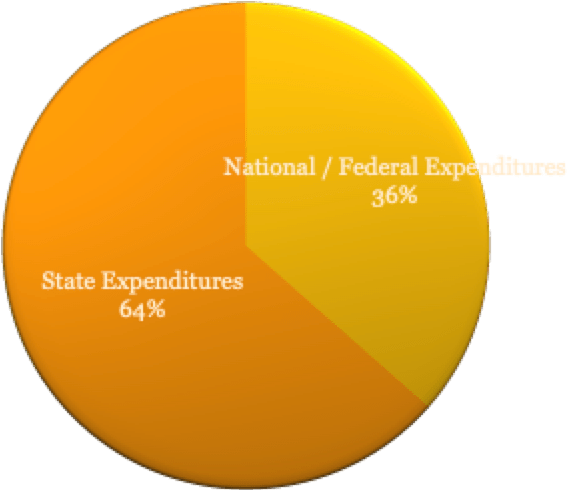

Breakdown of Federal Expenditures for Illegals
| Expense | Cost ($) |
| Federal Education Expenditures | 6,602,699,000 |
| Federal Medical Expenditures | 25,129,361,000 |
| Federal Law Enforcement | 23,132,475,000 |
| Federal Welfare Programs | 11,584,567,000 |
| Total | 66,449,136,000 |
Source: FAIR 2023 report
Healthcare Expenditures
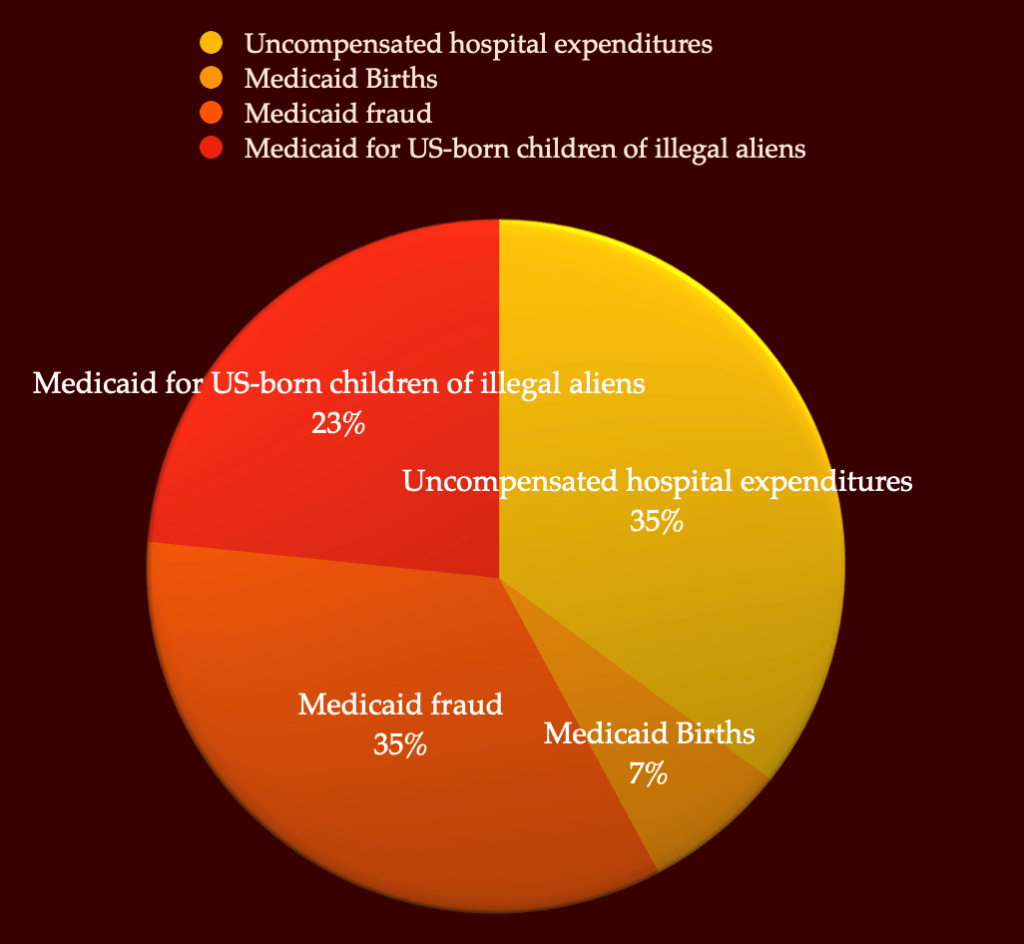
Although undocumented immigrants are not directly eligible for federal healthcare benefits, there are four major categories of government healthcare expenditures that benefit them or their U.S. born children. Estimates of the federal expenditures in these categories from the FAIR report are shown in Exhibit 2 below.
One important category is federal and state expenditures on emergency care provided to uninsured individuals. Medicaid expenditures on alien births and on healthcare provided to U.S.-born alien children are the next two categories, and fraudulent payouts due to misrepresentation of eligibility is the fourth.
Another important source on costs of hosting the undocumented immigrant population is a November 2023 report from the Committee on Homeland Security of the U.S. House of Representatives (House Committee report). 4 According to this report, the uninsured rate of undocumented immigrants possibly exceeds 50 percent; it is no doubt much higher than that of the American citizen (8.4 percent as of 2023). This imposes significant unreimbursed costs on U.S. healthcare providers, a large share of which ultimately is transferred to taxpayers through federal and state assistance to the providers.
As shown in Exhibit 2, the share of these costs borne by the taxpayer surpassed $8.15 billion in federal expenditures in 2022. This total would include Medicaid expenditures on emergency services to illegal immigrants and grants to state programs that provide subsidized healthcare services to this population.
Some state and local governments, such as New York City and the state of California, provide healthcare services to undocumented immigrants through programs established to serve low-income uninsured residents. State assistance to healthcare providers, which includes the states’ shares of the Medicaid and the various programs’ costs, is estimated to total $4.5 billion, according to the FAIR report.
These programs, which have expanded in response to the migrant influx, often look to the federal government to reimburse them for the very programs they created in the first place. As a result, the federal government ends up subsidizing benefits to illegal aliens for which they are otherwise federally unqualified.
The U.S. Department of Health and Human Services provides detailed data on Medicaid expenses by type, including a line item for Medicaid payments to healthcare providers to covering emergency services offered to undocumented immigrants. As shown in Exhibit 3, after spiking during the COVID period, these payments remained well above historical levels as of fiscal year 2023.5
Medicaid also covers reproductive care for the many alien mothers who give birth each year in the United States. According to one study, these births numbered 250,000 children in 2016 alone, around six percent of total births that year. 6
This benefit is available whether the recipient has been present for an extended period or has entered specifically to give birth in an American medical facility (in which case the child is born an American citizen). It has been reported that the latter situation accounts for thousands of births every year.7
Exhibit 2- Federal Expenditures on Healthcare for Aliens
| Service provided | Cost ($) |
| Uncompensated hospital expenditures | 8,153,000,000 |
| Medicaid Births | 1,596,902,000 |
| Medicaid fraud | 7,997,566,000 |
| Medicaid for US-born children of illegal aliens | 5,385,007,000 |
Source: FAIR 2023 report
Exhibit 3: Medicaid Payments ($) Covering Emergency Services for Undocumented Immigrants

Law Enforcement and Judicial Costs
Under the Biden administration, lax federal border policy has overwhelmed existing enforcement resources, enabling migrants to stream into the country with minimal screening. This creates additional costs, incurred to process such large numbers of migrants while securing the border to the extent feasible
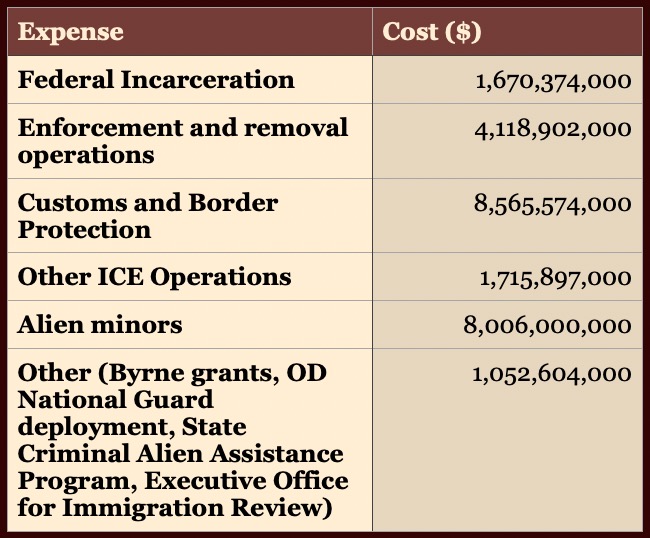
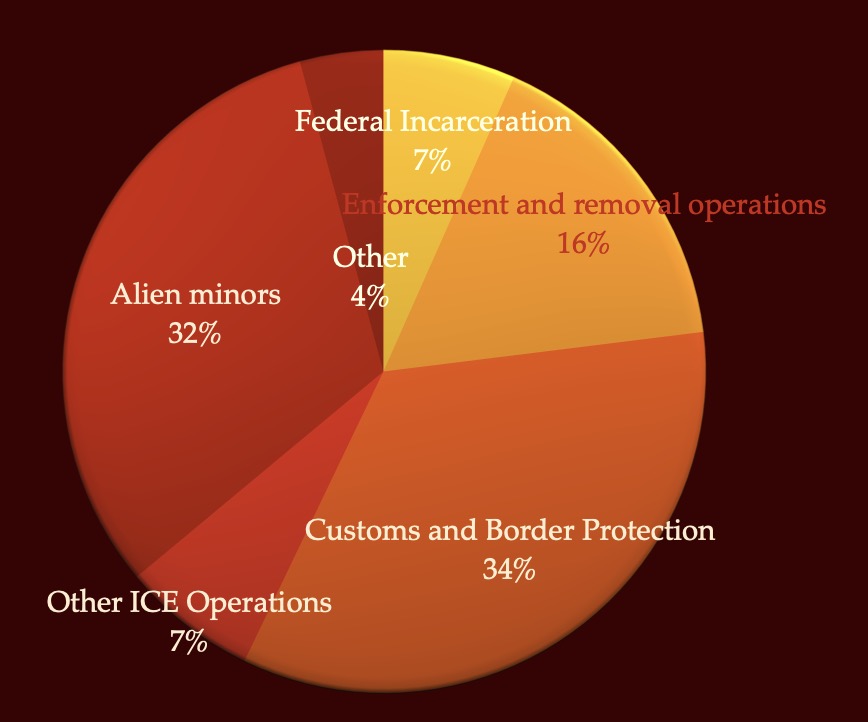
In fiscal year 2022, over $8.6 billion was allocated by Congress to CBP border security operations police resources related to migrants. An additional $4.1 billion was allocated to ICE enforcement and removal operations in the interior of the country. Exhibit 4 below presents a full breakdown of federal costs for justice and law enforcement expenditures in 2022 as detailed in the FAIR report.
The federal expenditure amounts include not only border security costs but also billions of dollars spent on new, expanded, or upgraded migrant processing centers and on operating costs for these facilities.8 They also include reimbursements to state and local governments and non-governmental organizations offering services to the migrants. Much of these added costs would have been unnecessary had the migrant influx been stemmed or prevented. Rather than help curb the migrant influx, such activities likely encourage it, by ensuring that more migrants are released without any prior detention.
In absence of strong border policy from the Biden administration, affected states have had to increase their resource expenditures. As described in the House Committee report, these span a wide range of activities, from pursuits and detentions to even autopsies and burial of deceased migrants.
State expenditures tied to undocumented immigrants in 2022 include policing costs of close to $9 billion, prison costs of $6.2 billion, and judicial costs of $3.7 billion, according to the FAIR report. Florida alone has been spending an extra $100 million per year according to the House Committee report.
Due to the migrant influx and insufficiency of federal assistance, two border states, Arizona and Texas, drastically increased expenditures to retain personnel and equipment on their borders. Texas allocated the largest amount–over $4 billion as of fiscal year 2023.9 Governor Ron DeSantis of Florida assisted Texas by deploying Florida law enforcement personnel and equipment to the Texas border and coastline, as described in the House Committe report.
The migrant influx has also caused financial burden for local law enforcement, with numerous examples offered in the House Committee report. For example, a sheriff in McMullen County, Texas, told the Committee that in 2022 alone, the county, which is home to just 600 legal residents and lacks its own jail, “spent more than $224,000 to pay a neighboring county to detain prisoners on smuggling-related charges.” A sheriff from Cochise County, Arizona reported that in 2022, the county had incurred $4.3 million in border-related booking costs with nearly 1,600 suspects booked into the county jail for border-related crimes.
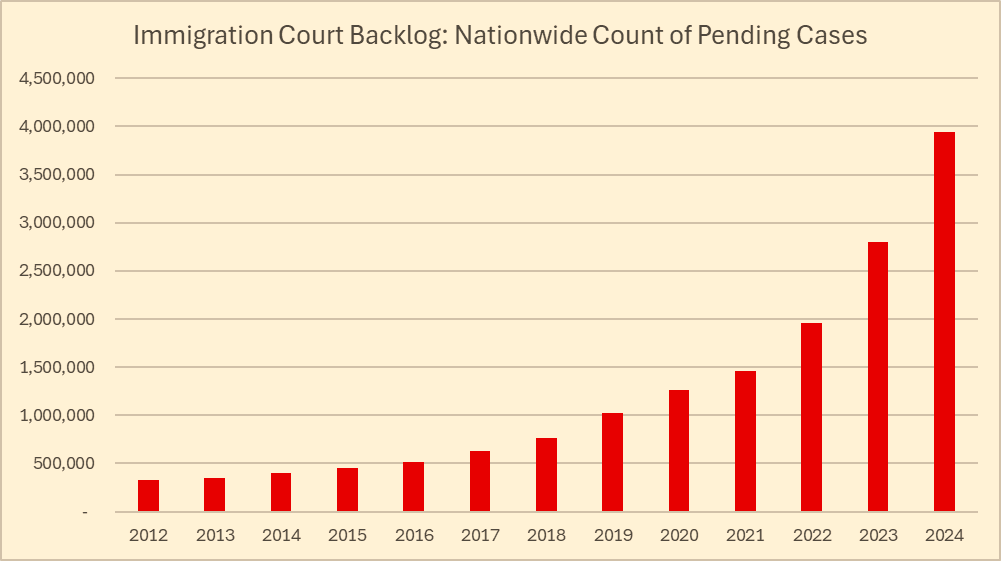
In most cases, entry granted to migrants is temporary and subject to an order to appear at a later date for an immigration court hearing to decide their eligibility to remain. Exhibit 5 presents a bar chart showing the backlog in pending illegal alien cases by year for 2012 through 2024, which has seen a sharp increase in number of cases in the last few years. The current immigration policies are allowing increasing numbers of aliens to live in the United States for extended periods of time while awaiting a final status hearing, which will result in future judicial costs.
Exhibit 4: Federal Law Enforcement Expenses
Source: FAIR 2023 report
Exhibit 5: Immigration Court Backlog Nationwide
Source: Transactional Records Access Clearinghouse, Syracuse University10
Education Costs
The costs of providing education to an expanding number of children in undocumented immigrant households skyrocketed under the Biden administration. The large numbers of these children have stressed the educational system, all the more so because most of these children don’t speak English, resulting in elevated costs.
The FAIR report estimates that as of the 2021-2022 school year, “5.1 million public school students – roughly 6.5 percent of total U.S. enrollment – are the children of illegal aliens or are illegal aliens themselves.” Of this population, at least 3.8 million “qualify as limited English proficiency (LEP) student.” The cost to taxpayers of educating this population is estimated at $58.8 billion for the LEP students and $16.9 billion for the non-LEP, totaling $75.7, with states and localities shouldering the vast bulk of the burden.11
These estimates were based on updating an earlier analysis from FAIR – a 2022 report that focused on education costs during the 2020-2021 school year.12 A comparison across the two reports indicates that new migrants arriving over the in-between, one-year period are costing the education system an additional $5 billion per year.
The vast numbers of aliens flooding school districts is beginning to overwhelm the systems. Again, the House Committee report provides multiple, stark examples. In Fairfax County, Virginia, 25% of all students in the district are LEP. Indianapolis, Indiana observed an increase of over 27,000 LEP between 2022 and 2016. In Chicago, the city budgeted $15 million in additional funds for schools to provide bilingual instruction for the 2023-2024 school year, providing for 2,000 additional children.
Notwithstanding their undocumented status, many alien children are recipients of federal grants. For instance, as noted in the House Committe report children of illegal aliens are eligible for assistance under the federal Every Student Succeeds Act. The FAIR report estimates that around 25 percent of Head Start enrollment is composed of illegal alien children or children of illegal aliens.
Welfare, Housing and Shelter Costs
Illegal immigration places a significant cost burden on financial aid programs intended for low-income Americans’ housing and welfare needs. Costs are borne both at the federal level and by states and localities.
Alien adults do not legally qualify to participate in federal programs. However, many undocumented migrant families benefit from food assistance, childcare, and supplemental income programs for which their US-born children qualify. In addition, mixed-status households may benefit from housing assistance.
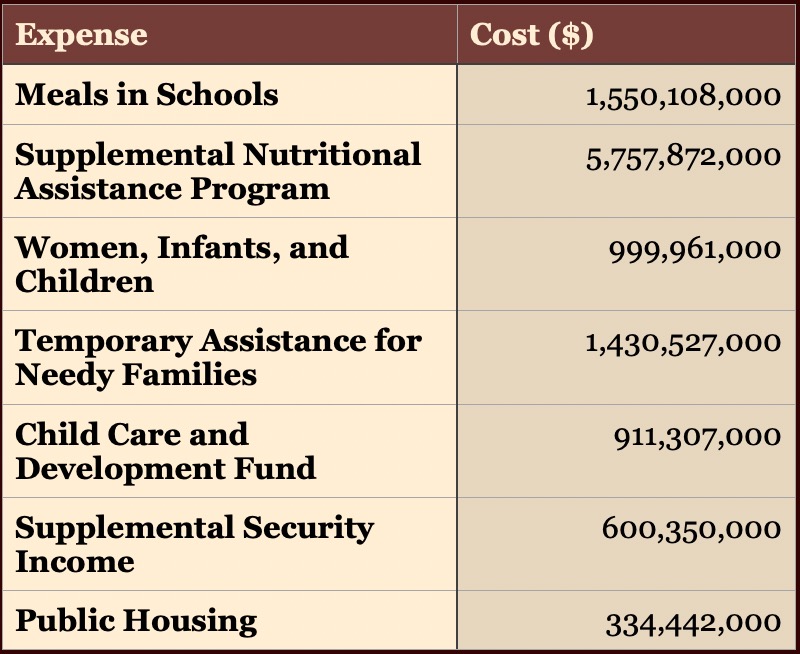
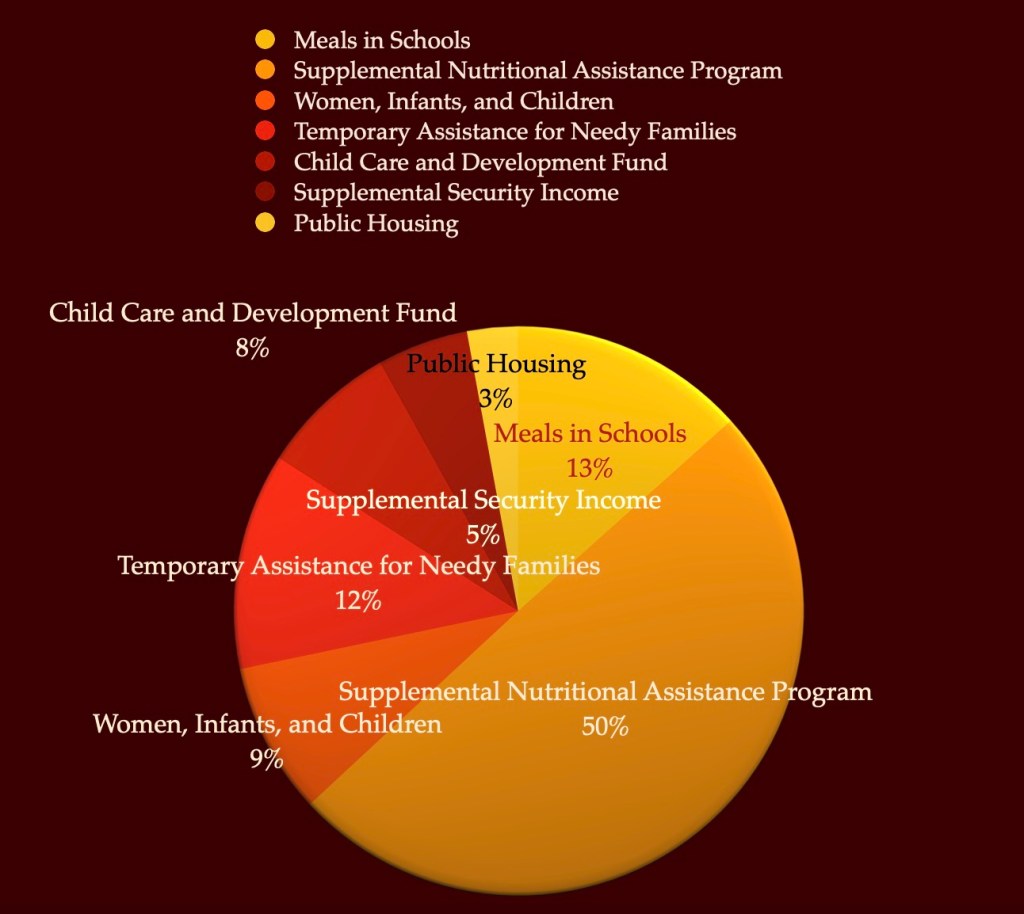
The Fair Report estimates that in fiscal year 2022, nearly $11.6 billion was spent by the federal government aiding undocumented immigrant families through such programs. The breakdown of these federal expenditures is shown in Exhibit 6 below.
The largest cost categories are the federal school meal programs and the Supplemental Nutritional Assistance (SNAP) Program, commonly referred to as “food stamps”. An estimated 2.1 million children of illegal aliens were eligible for SNAP as of 2022, with an average monthly federal expenditure per participant of about $230, leading to FAIR’s estimate of $5.8 billion total expenditure.
States contribute a share of the costs for some of these programs, with the state contribution estimated by FAIR total about $2 billion in fiscal year 2022. In addition to that, cities and towns have had to allocate huge sums of money on migrant shelters, hotels, gyms, and other facilities to house migrants, with the House Committe report offering numerous examples.13 In Chicago, $20 million per month is being spent towards housing aliens, worsening the city’s budget deficit. El Paso has been spending $300,000 a day, 20% of its budget. Washington, D.C. reportedly has run out of hotel space on account of rooms allocated to migrants. Maine, over a thousand miles from the border, has seen a historic influx of migrants that has overwhelmed local budgets and housing capacities.
New York City signed a $275 million contract with the Hotel Association of New York in early 2023 to house 5,000 individuals–a cost of $55,000 per person. According to the House Committee report, by August 2023 more than 57,000 illegal aliens were present in the city, with Mayor Adams reporting that the costs of sheltering this population were exceeding $9.8 million per day. This daily expenditure, equivalent to around $3.6 billion per year, reportedly surpassed the combined budgets of several New York City departments, and exceeded the entire budget of Dallas, Texas. In March 2023, the city submitted a request to the Federal Emergency Management Agency for reimbursement of $650 million dollars to help offset these costs.
Individual localities bear a variety of other additional significant costs of assisting migrants. For example, after illegal aliens were sent from New York City to Rochester County, New York, the city of Orangetown spent an additional $1 million to help food banks restock their shelves. 14
Exhibit 6: Alien Welfare Expense Breakdown
Source: FAIR 2023 report
Damage to Private Property along the Border
On top of the costs imposed on taxpayers by the migrant influx, the mass migration along the southwest border has taken a toll on private property and the environment. The number of incidents, the amount of damage or losses, and the cost of those damages only increase with the number of crossings.
As narrated by officials and citizens who’ve testified before Congress and summarized in the House Committee report, damage and devastation to private property and crops has posed challenges to farmers and ranchers in the border area.15 For instance, one South Texas rancher claimed that he’d spent up to $40,000 on property repairs. Another testified to $100,000 in property damage, including cars driving through fences. A fifth-generation rancher in Arivaca, Arizona, testified to bearing $60,000 in property repair costs per year and a $1 million loss in property value.
The sheriff of Kinney County, Texas, testified that “migrants had damaged or broke into houses, torn down fences, and left loads of trash on property in his county–and some owners have stopped rebuilding their fences”. The sheriff Yuma County, Arizona testified that the county has had to invest tens of dollars installing portable restrooms in agricultural fields to help prevent human waste damage to crops.16 Farmers in Yuma County, Arizona have sustained “staggering” amounts of crop damage and loss, forcing them to invest large sums in fencing and security.
Farming advocacy organization have also spoken out. In a letter to Department of Homeland Security Secretary Mayorkas, the American Farm Bureau Federation and the farm bureaus of all 50 states and Puerto Rico wrote, “Farm and ranch families, many of whom have owned land for generations, are bearing the brunt of this unprecedented influx and have border never seen a more dire situation.” The harm inflicted by migrants on the region’s agricultural has national repercussions, as the region is a major supplier of leafy green produce throughout North America through much of the year. 17
As noted in the House Committee report, fire damage is spreading, with migrants sometimes intentionally set fires in order to be noticed by border patrol to indicate they are lost. Migrants often break water lines to get access to drinking water and leave behind trash that can be digested by animals, leading to further losses. Property owners also fear ticks and illnesses like cattle fever that are brought by the crossers. Escaped, lost, and dispersed livestock is another common significant harm.
These scenes only scratch the surface of the unfortunate reality of the overlooked livelihoods of disheartened southwestern farmers and ranchers, who are an integral part of their regional economy and have national ramifications for food supply.
Costs of Transporting Migrants
The Biden administration has footed the bill to transport aliens from entry points to localities across the country, a cost ultimately borne by taxpayers. The administration ramped up operations to transport migrants by contracting these out to private firms or non-governmental entities. The costs of these operations stand apart from transport costs incurred directly by ICE and other law enforcement agencies, which are already accounted for in the law enforcement expenditure amounts cited previously.
In particular, in 2021 the federal government expanded its relationship with a private security and intelligence firm, MVM Inc., to transport family units and unaccompanied minors, doubling the size of its contract to $128 million. By September 2023, the cost for these services had accrued to $660 million.18
Border states themselves have shouldered much additional burden to transport migrants to the interior, which they have opted to do to ease the crisis situations they face. For instance, as documented in the House Committee report: 19
- Between April 2022 and October 2023, the state of Texas sent more than 51,800 illegal aliens to major cities around the country, including Washington, Chicago, New York and Philadelphia, costing upwards of $75 million for bus companies.
- In Arizona, from May-August 2022, 43 buses departed from the state to Washington, D.C., bringing 1,600 aliens to the east coast. Each bus cost around $83,000, bringing the total to about $35 million.
- Then, in Florida, $12 million has been allocated by the Florida Department of Transportation to combat the Biden administration’s sending of migrants to the state.
The Takeaway – The Prioritization of Illegal Immigrants above Citizens
Also important to consider, alongside taxpayer borne government expenditures, are unreimbursed costs borne by institutions such as schools and hospitals, and indirect costs borne by private citizens. The latter often takes the form of resources and services diverted to benefit undocumented immigrants.
As aforementioned, likely only half of aliens are insured, so that aliens rely on emergency care providers, whose costs are transferred to the American taxpayer. But this also leads to the unsurprising fact that illegal immigrants have been flooding and filling hospitals, including emergency rooms, in border states.
Also as aforementioned, illegal aliens, and children thereof, are taking up space and straining capacity in American school districts. This often results in crowded classrooms and resources diverted to meeting the need for educating non-English speaking pupils. Financial support and scholarships that would otherwise have gone to citizens or permanent residents are now being handed to children of undocumented immigrants.
Numerous examples of such are documented in the House Committee report.20 One doctor from Yuma, Arizona, has testified that the skyrocketing number of migrants coming to his hospital is a major strain on hospital capacity, often requiring triple the usual quantity of human resources “to resolve their cases and provide them with a safe discharge.” One San Diego, California hospital described having to pay $1.5 million more in 2021 than in the previous year solely due to care provided to aliens.
Residents of Chicago’s South Shore pushed back against the city’s plan to house aliens including in a local K-mart supermarket and former high school, according to the House Committee Report. These testimonies also illustrate how the growing presence of migrants disproportionately affects minority communities in many cities. One South Shore resident quoted in that report decried how police resources were being diverted from high-crime neighborhoods:
“We’ve had a problem with police response in our neighborhood in the past, so to bring someone in, say they’re going to have police presence for 24 hours a day, does a couple of things. First of all, it’s slap in the face to those of us who have not had a police presence when we needed it. Secondly, it provides a resource to someone who does not pay taxes in our community when we have been starving for those resources ourselves.” 21
The situation with fentanyl and other substances trafficked across the southern border also comes into play in considering the costs to taxpayers of an unsecured border and would be remiss not to mention. The opioid epidemic, which has taken millions of lives nationwide in the last decade, including hundreds of thousands in the last four years, cost the taxpayer a whopping $1.5 trillion in 2020, a 35% increase from three years prior, in expenses such as medical and law enforcement expenses. 22 States, and obviously not just border states, bear devastating costs for this situation, in terms of both healthcare and law enforcement.23
The migrant crisis has disadvantaged ordinary citizens in small ways as well as large. For instance, in the Boston area in October 2023, “scores of military veterans, service academy graduates and families are scrambling to find hotel rooms” for the annual Army-Navy football game after one hotel management company effectively canceled reservations for at least 70 rooms at three hotels to house aliens instead. 24
Homeless citizens have been perhaps the most unfortunate indirect victims of the migrant crisis. The number of homeless Americans jumped a record 11% during 2022 to 557,000 people due to rising housing costs, and they must compete for limited shelter space with illegal aliens.25 The Biden administration apparently has created situations where needy veterans live on the streets while aliens are housed on the dime of the taxpayer.
In August 2023, the administration requested $600 million from Congress to appropriate to FEMA’s Shelter Services Program.26 Rather than enforce border laws and care for homeless Americans, the Biden administration accomplished the opposite–enabling illegal migrants to stay in the country and diverting resources for sheltering the homeless.
Beyond these various indirect costs, one should also factor in the effect of millions of undocumented immigrants added to labor and housing markets. Basic economics implies that this influx depresses hourly wages for low- and moderate-income citizens while driving up their housing costs.
The surge potentially also ushers in a shift in interior demography that is disruptive to the electoral process. For instance, Census counts used to allocate seats in the U.S. House of Representatives do not distinguish alien residents from the total population of each House district.
As the plaintiffs in Texas v. Department of Homeland Security stated in their 2023 complaint against the Biden Administration’s proposed alien parole program, the administration’s policies have caused “substantial, irreparable harms.”27 These policies have placed many states and localities in untenable situations, enabling “potentially hundreds of thousands of additional aliens to enter each of their already overwhelmed territories.”
The current immigration has severely stressed public and private resources originally intended for the benefit of the citizen. American citizens, as it stands now, are paying out of their own wallets, directly or indirectly, for a subversion of the nation’s sovereignty imposed on them by their own government. Our border must be repaired if our nation is to best protect the safety of its citizens and provide adequate resources to meet their economic and social needs. The longer the influx continues unabated, the greater the cost to the average American taxpayer and the greater the corrosion to the sovereignty of the nation as a whole. We must end it in the name of God.
Footnotes
- See “The Fiscal Burden of Illegal Immigration on United States Taxpayers:2023.” Federation for American Immigration Reform, March 8, 2023. See also the testimony of FAIR Executive Director Julie Kirchner before the House Budget Committee, May 8, 2024. ↩︎
- See “Costliest U.S. Tropical Cyclones.” National Centers for Environmental Information, November 1, 2024. Note that the cost estimates in that study are in 2024 dollars, and therefore are inflated relative to the dollar estimates in the FAIR report. ↩︎
- See Office of the Mayor, “As City Nears Arrival of 100,000 Asylum Seekers Since Last Shttps://gov.texas.gov/news/post/operation-lone-star-escalates-unprecedented-border-security-effortspring, Mayor Adams Lays out Updated Costs if State and Federal Governments do not Take Swift Action.” August 9, 2023. ↩︎
- See “The Historic Dollar Costs of DHS Secretary Alejandro Mayorkas’ Open Border Policies.” Committee on Homeland Security Majority Report, November 13, 2023. ↩︎
- See the Financial Management Reports for Fiscal Years 2016 through 2023. ↩︎
- See Jeffrey S. Passel, D’Vera Cohn, and John Gramlich, “Number of U.S.-born babies with unauthorized immigrant parents has fallen since 2007,” Pew Research Center, November 1, 2018. ↩︎
- See Pawel Styma, “Birth Tourism,” Federation for American Immigration Reform, March 4, 2020. ↩︎
- See pages18 and 19 of the House Committee Report for examples of specific new expenses incurred by the CBP. ↩︎
- State of Texas, Office of the Texas Governor, “Operation Lone Star Escalates Unprecedented Border Security Efforts“, November 18, 2022. ↩︎
- Accessed 10/14/2024. States and territories without a complete time series of cost information (VI, VT, TN, PR, PA, NE, MS, MI, MN, ME, KS, IN, CT, CO, AR, and AK) are excluded from the calculations. ↩︎
- See pages 42-43 of the FAIR report. ↩︎
- See “The Elephant in the Classroom: Mass Immigration Imposing
Colossal Cost and Challenges on Public Education.” Federation for American Immigration Reform, September 2022. ↩︎ - See pages 29-33 of the House Committee report. ↩︎
- U.S. Congress, House of Representatives, Judiciary Committee, Subcommittee on Immigration Integrity, Security and Enforcement, Prepared Testimony of Teresa Kenny for The Biden Border Crisis: Part III, 118th Cong., 1st sess., May 23, 2023, 3, ↩︎
- See pages 33-40 of the House Committee report. ↩︎
- U.S. Congress, House of Representatives, Judiciary Committee, Prepared Testimony of Leon N. Wilmot for The Biden Border Crisis: Part II,1 18th Cong., 1st sess., February 23, 2023. ↩︎
- See “Letter to Secretaries Mayorkas, Vilsack, and Haaland,” The American Farm Bureau Federation, June 3, 2021. ↩︎
- See the House Committee report, page 48. ↩︎
- See page 47 of the House Committee report. ↩︎
- See pages 8-11 and pages 22-25 of the House Committee report. ↩︎
- “Chicago Residents Take Legal Action over Migrant Housing Plan,” Fox News, Fox News video, 04:49, May 16, 2023, ” ↩︎
- U.S. Congress, The Joint Economic Committee, Democrats, The Economic Toll of the Opioid Crisis Reached Nearly $1.5 Trillion in 2020, 117th Cong., 2nd sess., September 28, 2022, ↩︎
- See pages 11-15 of the House Committee report for further discussion of the impact of the fentanyl crisis on American citizens. ↩︎
- Joe Battenfeld, “Battenfeld: Army-Navy game at Gillette has turned into ‘cluster’ because migrants have taken up hotel rooms,” The Boston
Herald, October 4, 2023. ↩︎ - Jon Kamp and Shannon Najmabadi, “More Americans Are Ending Up Homeless—at a Record Rate,” The Wall Street Journal, August 14, 2023. ↩︎
- See page 44 of the House Committee report. ↩︎
- See page 49 of the House Committee report. ↩︎
 Unrivaled Politics