We have previously opined at this site about the Biden administration’s lax policies on the southern border, enabling a massive influx of aliens, amongst them large numbers of gang members, traffickers, and common criminals. We also have covered the new Administration’s efforts in stopping the flow. However, recent times have seen a complex plot twist, as the Administration is finding out that it was easier to let the migrants in illegally than to deport them legally.
To remind, on March 15, Trump signed an executive order invoking the Alien Enemies Act to deport certain criminal aliens, namely members of the Venezuelan gang Tren de Aragua and Salvadorian gang MS-13. The administration argued that the presence of these violent gangs constituted a threat to the national security and public safety and constituted a “predatory incursion”, therefore covered by the Act. The Act, which dates to 1798, gives the administration the power to summarily deport such aliens, argues the administration.
Earlier, on February 20 the State Department had declared Tren de Aragua a foreign terrorist organization in compliance with a separate executive order, a declaration which still stands today. The order invoking the Act asserts that TDA is conducting “irregular warfare” throughout the country at the direction of Venezuelan government.
The administration argued 50 U.S.C. 21 section of the Act applied, which reads, in full,
“Whenever there is a declared war between the United States and any foreign nation or government, or any invasion or predatory incursion is perpetrated, attempted, or threatened against the territory of the United States by any foreign nation or government, and the President makes public proclamation of the event, all natives, citizens, denizens, or subjects of the hostile nation or government, being of the age of fourteen years and upward, who shall be within the United States and not actually naturalized, as alien enemies.”
However, a defiant judiciary across various jurisdictions adopted the role of obstructing these efforts, giving rise to a tangled array of judicial orders and decisions.
Lawfare gone wild
Immediately following President Trump’s March 15 proclamation, US district court judge James Boasberg issued a temporary restraining order barring the administration from using the Alien Enemies Act to rapidly deport Tren de Aragua gang members.
Boasberg ruled that the gang members were entitled to challenge the finding that the are deportable under the Act. The temporary restraining order was initially was set to expire in two weeks but was later extended through April 12.
This order was then appealed by the administration to the Supreme Court, which ruled on April 7 that the Trump administration could resume the deportations under the Alien Enemies Act. However, the Court indicated that these individuals are entitled to a notice of their deportation and an opportunity to challenge it.
The Supreme Court’s ruling prompted a series of lawsuits seeking to prevent further deportations under the Act. In early May, Federal district judges in Texas, New York and Colorado ruled against the administration’s use of the Act.
These judges ruled that the administration’s use of the Act was either unlawful or of questionable legality and that those challenging their deportation were likely to succeed on the merits. Then, in a plot twist, another federal district court judge, Stephanie Haynes in western Pennsylvania, ruled in favor of the administration.
After the 5th Circuit Court sidestepped an appeal of the Texas district court ruling, claiming that it lacked jurisdiction, the US Supreme Court again stepped in. This time, in a full-circle moment, the Court delivered a serious blow to the administration’s use of the Act. Whereas, in its early April ruling, the Court had allowed the resumption of the deportations, on May 19th, ruled that at least for the time being, the Act may not be used for this purpose.
Specifically, the Supreme Court ruled that the pretexts of the Alien Enemies Act must first be decided by the 5th Circuit Court. In other words, the case was to be sent back to the 5th Circuit, which oversees appeals cases coming out of Texas and is often seen as not strict constitutionalist. The Court barred the administration from carrying on with the deportations until this process plays out. In addition, the Court reiterated that the deportees are entitled to a fair hearing.
Four of the six Republican appointees–John Roberts, Amy Barrett, Brett Kavanaugh, and Neil Gorsuch, sided with the liberal justices to stop the deportations. Clarence Alito and Samuel Thomas were the sole dissenters.
The Court, both in April and early May did not deny the legality of the administration’s use of the Alien Enemies act. “The Government is directed not to remove any member of the putative class of detainees from the United States until further order of this Court,” the April order states. The May hit pause on the matter, placing the question of legality back to a lower court to opine on.
The Administration Has a Strong Legal Case for Use of the Act
The Supreme Court has not yet addressed the constitutionality of using the Alien Enemies Act to deport members of the Venezuelan prison gang. Rather, the Court consistently found that “judicial review” had been requested in the wrong court. In April, the Court indicted that attorneys for the deportees should have filed their lawsuit in Texas, where the plaintiffs were being held, instead of in Judge Boasberg’s D.C. venue.
There are multiple reasons to believe that the Administration is on a sound Constitutional footing in seeking to apply the Alien Enemies Act, while what is required for “due process” remains an open question. That said, given the Supreme Court’s allusions to the need for a “fair hearing” for deportees, mass deportations under the Act may become impractical.
As legal context, the Supreme Court in 1948 confirmed the Alien Enemies Act was a power of the Executive (the President) under Article II, Section I of the US Constitution. The court rulings and injunctions are an apparent defiance of this precedent. The framers of the constitution, argues former Virginia Attorney General Ken Cuccinelli, did not limit the power to apply exclusively to military invasions, nor to require a Congressional declaration of war.1 Legal experts such as Joe DiGenova have likewise sounded off on what they consider to be abuse of jurisdictional power of the judges. 2
The DOJ has contended that the actions of Tren de Aragua fall squarely within the meaning of an invasion or predatory incursion: “The actions of TDA…[such as] illegal entry into and continued unlawful presence in the United States, is an ‘unwelcome intrusion’ that entails hostile acts contrary to the rights of U.S. citizens to be free from criminality and violence.” According to the DOJ, such an intrusion need not be military in nature or intended to occupy territory. 3
The American Civil Liberties Union (ACLU), which has filed many of the lawsuits against the administration’s use of the Alien Enemies Act, including at the Supreme Court, has relied on a questionable interpretation of the Act. The ACLU claims that an invasion or predatory incursion must take place by a government military or militia that is an arm of the government–that the “AEA cannot override the INA [asylum] provisions that were deliberately enacted to provide vulnerable individuals with meaningful access to protections from prosecution [sic] and torture”.4 Of course, asylum usually does not apply to convicted criminal alien gang members present in the United States.
Expert Reactions
Justice Alito claimed the Court had “no authority to issue any relief” to the aliens in his dissent from the Court’s May decision. Experienced lawyers and legal experts also sounded off on the decision. Stephen Miller, President Trump’s Chief of Staff for Policy is quoted as saying; “[the court] issued this order without receiving any information on this terrorist organization and the diplomacy that has been conducted. “5
Similarly, after the Supreme Court ruling, federal district judge James Ho issued a rare rebuke of the court’s ruling for a judge of his stature. He went as far as decrying the disproportionate amount of injunctions Trump has received compared to other presidents, stating he has “sincere concerns about how the district judge as well as the President and other officials have been treated in this case.” “I worry that the disrespect they have been shown will not inspire continued respect for the judiciary, without which we cannot long function,” Ho added. 6
Legal constitutional experts decry the liberal argument that illegal aliens are entitled to the same due process as citizens. Nowhere in the constitution does it explicitly state “equal protection” extends to people here illegally. Constitutional attorney John Eastman rightly states that the founders did not envision a time that would see the nation flooded with immigrants, let alone aliens, or criminal aliens–and certainly not giving those aliens rights. 7
Despite the lamentations of originalists, the administration’s use of the Alien Enemies Act could become impractical and come to an end with the May Supreme Court ruling because of “due process” impediments. The Trump administration will have to search for ways around the ruling or for better ways to deport, should the policy be slowed to an undesirable rate.
One potentially available option may suspending Habeas Corpus, a presidential power in Article II that would entail stripping the right of due process for a class of people within the United States on declaration of emergency. President Abraham Lincoln is famous for suspending habeas corpus during the Civil War, with significant blowback from his opponents. The action could serve, say legal scholars like Eastman, as a Constitutional last resort for the administration to facilitate deportations of illegal aliens.
As of now, the Trump administration claims to be ramping up all deportations, opening the aperture to deport up to 3,000 or more illegal aliens per day, not just violent criminals. The administration intends to use all available measures to circumnavigate the various judicial obstacles.
Only three months in, President Trump’s second Administration has reigned in lawlessness on the southern border, revamping the broken immigration system, stemming the flow of illegal crossings, and deporting criminal aliens. He has accomplished this despite resistance from many states and localities to helping enforce the law, a barrage of criticism from the media, and an activist judiciary seeking to block the agenda on which he was elected. Immigration statistics have seen drastic changes since President Biden left office.
ICE arrests per month have surged 627 percent since the change of administrations, helping to discourage illegal crossings.1 ICE’s ramped up efforts have resulted in the arrest of about 113,000 and deportation of about 100,000 illegal aliens, mostly with criminal records, as reports the administration.2 FAIR (Federation for American Immigration Reform) estimates that just these deportations alone will save taxpayers around half a billion dollars annually. 3
FAIR estimates that there remain an estimated 18.6 million illegal aliens residing in the United States4, but the deportation process, the government says, is only getting off the ground. The House of Representatives last month boosted funding for ICE in its reconciliation bill, in its allocation of $200 million to homeland security5. In the last week, the administration established buffer zones at a vulnerable area along the border dubbed the Roosevelt Reservation, encompassing land in California, Arizona and New Mexico, sending military equipment and troops to patrol these areas.6 Troops are authorized to make arrests of illegal crossers.
Trump has been gradually racking up victories in the court battles over his efforts to stem the flow of illegal migrants. Recently, for example, he sat down with President Nayib Bukele of El Salvador where he discussed, among other topics, the deportation of Kilmar Abrego-Garcia, a convicted member of MS-13, a Salvadorian gang, which Trump’s opponents have been trying to reverse. The Supreme Court had ruled this deportation lawful, as well as his use of the Alien Enemies Act to deport criminal aliens including Abrego-Garcia, but has since paused such deportations.
There remains a staggering amount of work ahead, involving dealing with uncooperative local governments, fighting court battles, and even possible military action on the cartels, for the administration to fulfill its ultimate goals on border security and immigration. In the meantime, however, let’s look at some of the most noteworthy statistics thus far regarding the immigration situation.
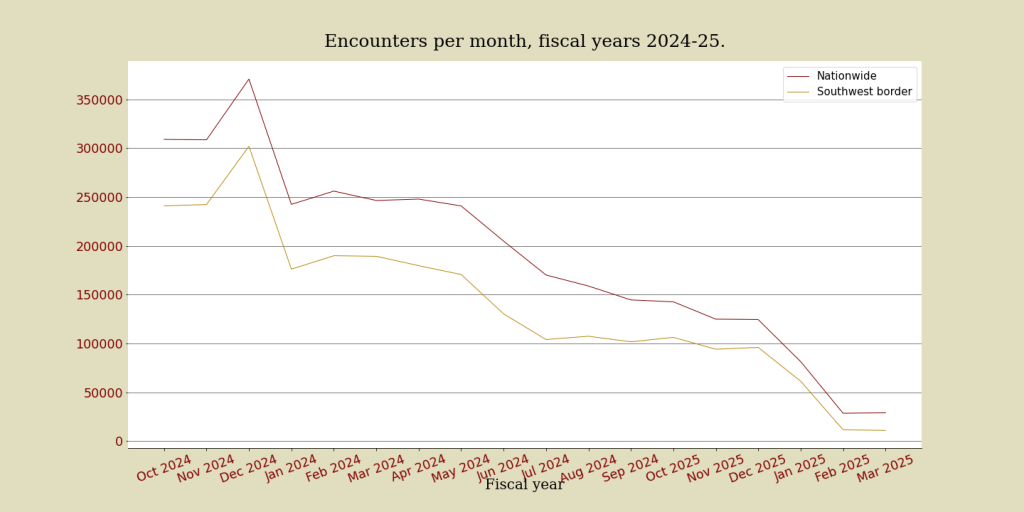
The chart below depicts monthly crossings since the start of fiscal year 2024. As seen in this chart, by February 2025, the first full month of Trump’s second presidency, illegal crossings were reduced to 29,000, from over 125,000 in December, Biden’s last full month. The February 2025 count, which was duplicated in March, amounts to less than 10 percent of Biden’s all-time high count (331,000 in December of fiscal year 2024).
A graphic showing the number of encounters per month for the last one and a half years; both nationwide and on the southwest (southern) border, which encompass most (but not all) crossers; Note the decline in FY January 2025 and again in February, Donald Trump’s first full month in the White House. (Source: USCBP)7
Рrior to Trump’s election in November, the number of migrant crossings per month sat at about 150,000, more than halved from previous highs at the end of fiscal year 2023, but still very costly to the nation. Very steep costs from illegal immigration had been imposed on the nation throughout the years of the Biden administration, which also illegally provided many illegal aliens with social security numbers, according to recent reports. Over 2 million, we know now, were given a social security number in 2024 alone.
As seen in the chart above, illegal immigration peaked around the end of 2023 and then gradually declined through the remaining months of the Biden administration. At this time, the Biden administration reinstated some of Trump’s рrevious policies to reduce the volume of crossings. Critics of Joe Biden and Kamala Harris claimed the administration instituted action to mitigate the crisis in part to mollify voters. However, this action was too little and too late, and Americans saw the border crisis as a key issue (40% per Rasmussen) and a reason to vote for Trump.
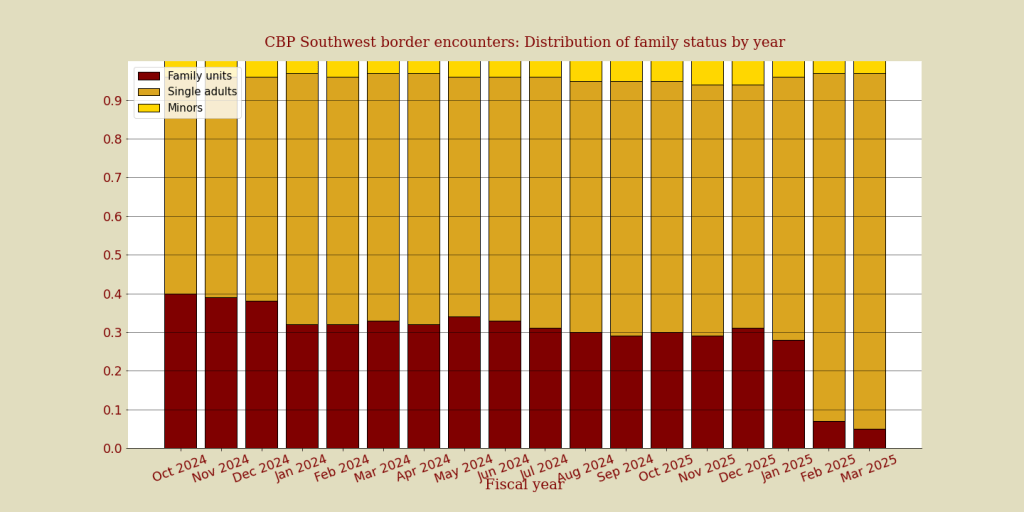
Another important statistic relates to the the changing family status of the border crossers that has accompanied the change in border policy between the Biden and Trump administrations. This is quite visible in the chart below, which shows breakdown of migrant crossings by family status by month since the beginning of fiscal year 2024 (October 2023).
A chart showing the distribution of family status of the migrants who crossed the US Southern Border; note the drop in family units (and minors) in February, Trump’s first month in office. (Source; USCBP)8
In March, migrant families comprised about 5 percent of all southern border encounters, following a 20 percentage point drop from January to February. In contrast, the family share ranged between 30 and 40 percent during the last 15 months of the Biden administration. Some have argued that the Biden administration policies encouraged illegal immigrants to bring their families, hoping that this would eventually expand the population of voters indebted to and voting for Democrats. This aspect aside, migration of family units clearly impose higher costs on taxpayers.
In sum, the data show that Trump administration has largely brought the migrant crisis under control, with what his supporters argue are sensible border policies completely in contrast to those of his predecessor. Trump, to reiterate, has much work in front of him in order to increase deportations and achieve his ultimate goals on homeland security. But even the 100,000 deportations of criminal aliens to date means less fentanyl and other dangerous drugs trafficked into the country, fewer children being sex trafficked, and safer streets for the American people.
According to FAIR, this is a low-end savings estimate, since most of the raids and deportation operations have occurred in large urban areas, where costs tied to illegal immigration are higher than average. ↩︎
The past few years we’ve seen plenty of news about the mass influx of illegal immigrants entering the US largely unvetted, and reports about crime and human trafficking connected to the situation. Americans subsequently see immigration as a top issue in the 2024 election. What you may have heard less about, however, are the direct and indirect costs of this massive influx to the American citizen. This article distills information on these costs from several key sources with the aim of providing an inclusive and concise summary.
A study released in early 2023 by the Federation for American Immigration Reform (FAIR) is the most comprehensive available source of data on the direct costs to taxpayers. FAIR estimates that in fiscal year 2022, illegal immigration levied a net $150 billion burden on federal, state, and local governments.1
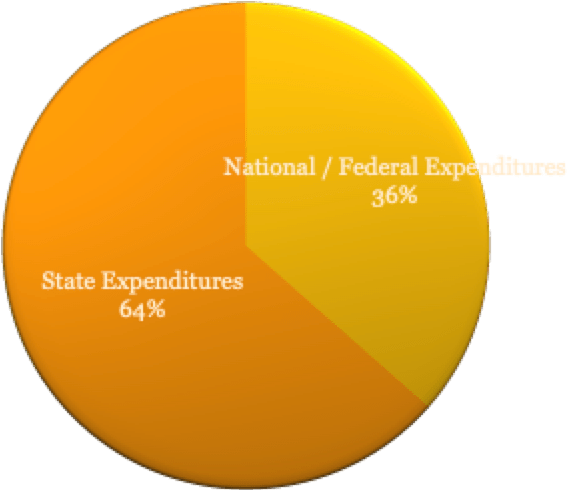
This reflects an estimated $182 billion in expenditures minus $32 billion in taxes contributed by those who lack citizenship or permanent residence status. Exhibit 1 below shows the total government costs, alien tax contributions and the divide between local and state (plus the burden on the taxpayer).
By comparison, the second costliest hurricane in U.S. history, Hurricane Harvey, is estimated to have cost the nation $160 billion.2 Perhaps, then, it would not be an overstatement to see the annual national cost of illegal migration as reaching catastrophic levels.
FAIR concludes that the average taxpayer paid $956 in fiscal year 2022 to compensate for alien migrants. In other words, because undocumented workers in large part do not pay income taxes, the American citizen taxpayer is obligated to foot the bill. FAIR also estimates that the annual net governmental cost of absorbing migrants had risen by $35 billion since 2017.
According to the FAIR report, the overall cost comprises government expenditures on medical care, law enforcement, education, and welfare assistance, also summarized in Exhibit 1. The report provides a methodical quantification of each of these categories, accompanied by an explanation of the assumptions required due to paucity of data. FAIR notes that the assumptions invoked are not worst case, so that actual costs may be higher than estimated.
FAIR’s estimates indeed do not appear overstated, considering that New York City alone, as of August 2023, was forecasting $3.6 billion in costs of caring for and accommodating its growing migrant population. As of that month, New York City was home to about 57,000 migrants, a small fraction of the national total, and this forecast is for just the cost borne by the city, exclusive of federal and state shares.3
Exhibit 1:Alien Net Burden on Taxpayers in Fiscal Year 2022
Total Federal Expenditures + Total State + Local Expenditures = Total National Expenditures $66,449,136,000…………………………$115,608,730,000………………………$182,057,865,000
Total Federal Taxes Paid + Total State & Local Taxes Paid = Total Tax Contributions $16,219,495,000……………………..$15,172,140,000……………………$31,391,635,000
Total National Expenditures – Total Tax Contributions = Total Burden on Taxpayers $182,057,865,000……………..$31,391,635,000……………..$150,666,230,000
Breakdown of Federal Expenditures for Illegals
Expense
Cost ($)
Federal Education Expenditures
6,602,699,000
Federal Medical Expenditures
25,129,361,000
Federal Law Enforcement
23,132,475,000
Federal Welfare Programs
11,584,567,000
Total
66,449,136,000
Source: FAIR 2023 report
Healthcare Expenditures
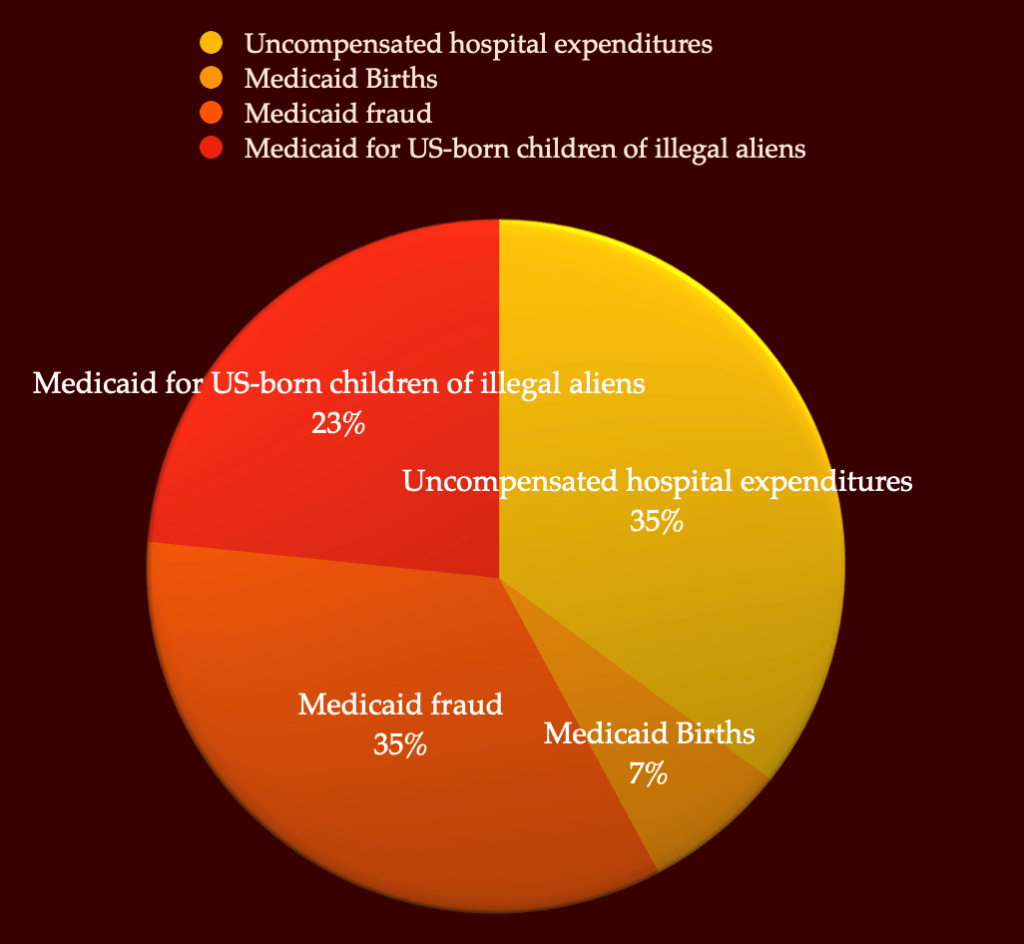
Although undocumented immigrants are not directly eligible for federal healthcare benefits, there are four major categories of government healthcare expenditures that benefit them or their U.S. born children. Estimates of the federal expenditures in these categories from the FAIR report are shown in Exhibit 2 below.
One important category is federal and state expenditures on emergency care provided to uninsured individuals. Medicaid expenditures on alien births and on healthcare provided to U.S.-born alien children are the next two categories, and fraudulent payouts due to misrepresentation of eligibility is the fourth.
Another important source on costs of hosting the undocumented immigrant population is a November 2023 report from the Committee on Homeland Security of the U.S. House of Representatives (House Committee report). 4 According to this report, the uninsured rate of undocumented immigrants possibly exceeds 50 percent; it is no doubt much higher than that of the American citizen (8.4 percent as of 2023). This imposes significant unreimbursed costs on U.S. healthcare providers, a large share of which ultimately is transferred to taxpayers through federal and state assistance to the providers.
As shown in Exhibit 2, the share of these costs borne by the taxpayer surpassed $8.15 billion in federal expenditures in 2022. This total would include Medicaid expenditures on emergency services to illegal immigrants and grants to state programs that provide subsidized healthcare services to this population.
Some state and local governments, such as New York City and the state of California, provide healthcare services to undocumented immigrants through programs established to serve low-income uninsured residents. State assistance to healthcare providers, which includes the states’ shares of the Medicaid and the various programs’ costs, is estimated to total $4.5 billion, according to the FAIR report.
These programs, which have expanded in response to the migrant influx, often look to the federal government to reimburse them for the very programs they created in the first place. As a result, the federal government ends up subsidizing benefits to illegal aliens for which they are otherwise federally unqualified.
The U.S. Department of Health and Human Services provides detailed data on Medicaid expenses by type, including a line item for Medicaid payments to healthcare providers to covering emergency services offered to undocumented immigrants. As shown in Exhibit 3, after spiking during the COVID period, these payments remained well above historical levels as of fiscal year 2023.5
Medicaid also covers reproductive care for the many alien mothers who give birth each year in the United States. According to one study, these births numbered 250,000 children in 2016 alone, around six percent of total births that year. 6
This benefit is available whether the recipient has been present for an extended period or has entered specifically to give birth in an American medical facility (in which case the child is born an American citizen). It has been reported that the latter situation accounts for thousands of births every year.7
Exhibit 2- Federal Expenditures on Healthcare for Aliens
Under the Biden administration, lax federal border policy has overwhelmed existing enforcement resources, enabling migrants to stream into the country with minimal screening. This creates additional costs, incurred to process such large numbers of migrants while securing the border to the extent feasible
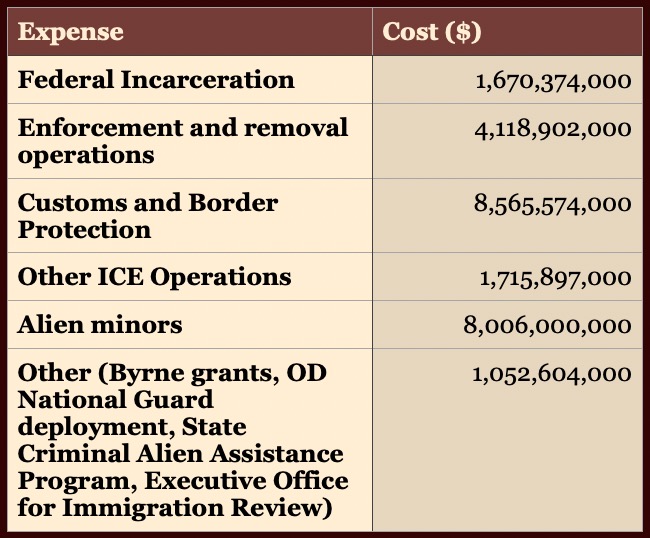
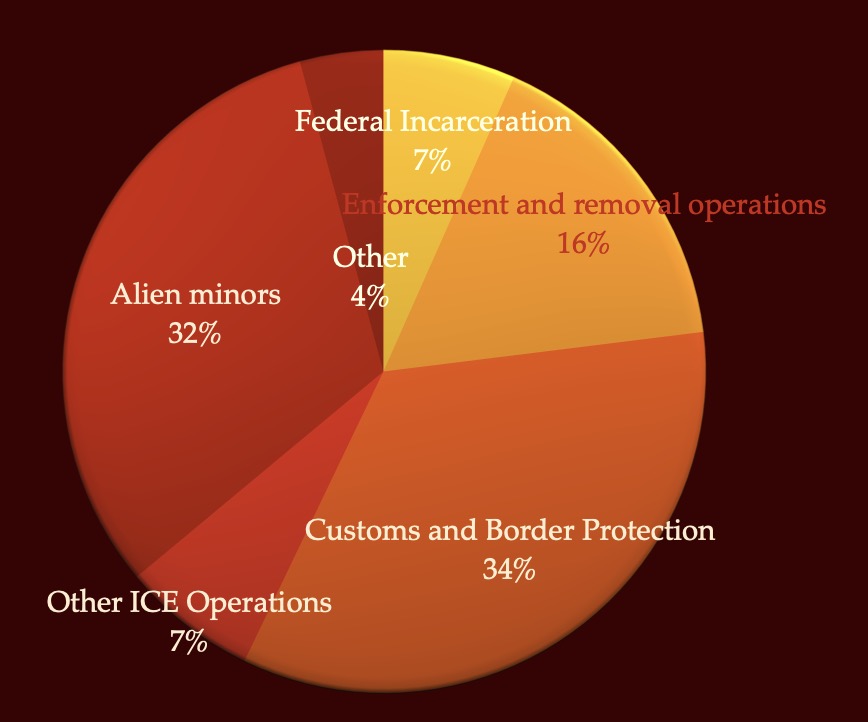
In fiscal year 2022, over $8.6 billion was allocated by Congress to CBP border security operations police resources related to migrants. An additional $4.1 billion was allocated to ICE enforcement and removal operations in the interior of the country. Exhibit 4 below presents a full breakdown of federal costs for justice and law enforcement expenditures in 2022 as detailed in the FAIR report.
The federal expenditure amounts include not only border security costs but also billions of dollars spent on new, expanded, or upgraded migrant processing centers and on operating costs for these facilities.8 They also include reimbursements to state and local governments and non-governmental organizations offering services to the migrants. Much of these added costs would have been unnecessary had the migrant influx been stemmed or prevented. Rather than help curb the migrant influx, such activities likely encourage it, by ensuring that more migrants are released without any prior detention.
In absence of strong border policy from the Biden administration, affected states have had to increase their resource expenditures. As described in the House Committee report, these span a wide range of activities, from pursuits and detentions to even autopsies and burial of deceased migrants.
State expenditures tied to undocumented immigrants in 2022 include policing costs of close to $9 billion, prison costs of $6.2 billion, and judicial costs of $3.7 billion, according to the FAIR report. Florida alone has been spending an extra $100 million per year according to the House Committee report.
Due to the migrant influx and insufficiency of federal assistance, two border states, Arizona and Texas, drastically increased expenditures to retain personnel and equipment on their borders. Texas allocated the largest amount–over $4 billion as of fiscal year 2023.9 Governor Ron DeSantis of Florida assisted Texas by deploying Florida law enforcement personnel and equipment to the Texas border and coastline, as described in the House Committe report.
The migrant influx has also caused financial burden for local law enforcement, with numerous examples offered in the House Committee report. For example, a sheriff in McMullen County, Texas, told the Committee that in 2022 alone, the county, which is home to just 600 legal residents and lacks its own jail, “spent more than $224,000 to pay a neighboring county to detain prisoners on smuggling-related charges.” A sheriff from Cochise County, Arizona reported that in 2022, the county had incurred $4.3 million in border-related booking costs with nearly 1,600 suspects booked into the county jail for border-related crimes.
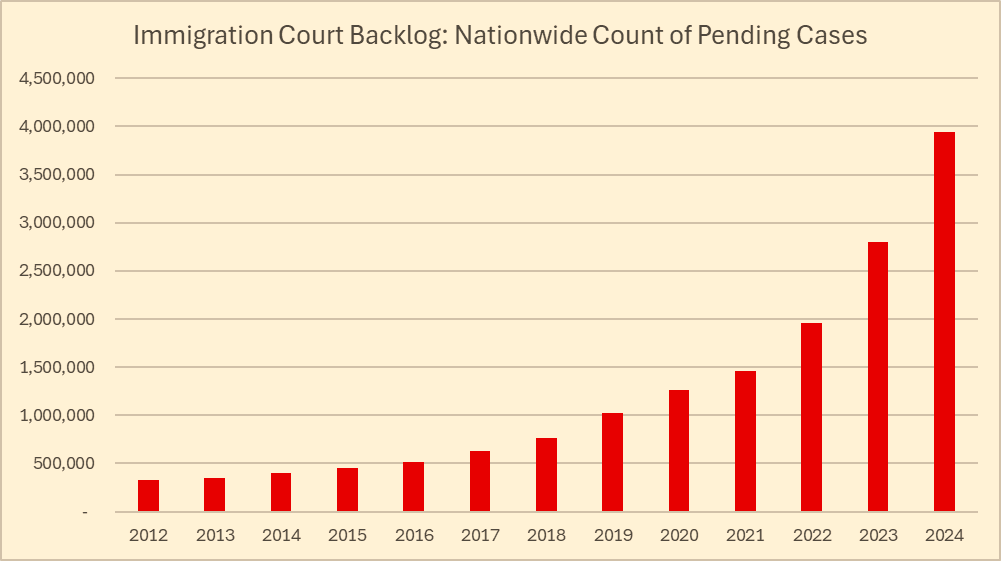
In most cases, entry granted to migrants is temporary and subject to an order to appear at a later date for an immigration court hearing to decide their eligibility to remain. Exhibit 5 presents a bar chart showing the backlog in pending illegal alien cases by year for 2012 through 2024, which has seen a sharp increase in number of cases in the last few years. The current immigration policies are allowing increasing numbers of aliens to live in the United States for extended periods of time while awaiting a final status hearing, which will result in future judicial costs.
The costs of providing education to an expanding number of children in undocumented immigrant households skyrocketed under the Biden administration. The large numbers of these children have stressed the educational system, all the more so because most of these children don’t speak English, resulting in elevated costs.
The FAIR report estimates that as of the 2021-2022 school year, “5.1 million public school students – roughly 6.5 percent of total U.S. enrollment – are the children of illegal aliens or are illegal aliens themselves.” Of this population, at least 3.8 million “qualify as limited English proficiency (LEP) student.” The cost to taxpayers of educating this population is estimated at $58.8 billion for the LEP students and $16.9 billion for the non-LEP, totaling $75.7, with states and localities shouldering the vast bulk of the burden.11
These estimates were based on updating an earlier analysis from FAIR – a 2022 report that focused on education costs during the 2020-2021 school year.12 A comparison across the two reports indicates that new migrants arriving over the in-between, one-year period are costing the education system an additional $5 billion per year.
The vast numbers of aliens flooding school districts is beginning to overwhelm the systems. Again, the House Committee report provides multiple, stark examples. In Fairfax County, Virginia, 25% of all students in the district are LEP. Indianapolis, Indiana observed an increase of over 27,000 LEP between 2022 and 2016. In Chicago, the city budgeted $15 million in additional funds for schools to provide bilingual instruction for the 2023-2024 school year, providing for 2,000 additional children.
Notwithstanding their undocumented status, many alien children are recipients of federal grants. For instance, as noted in the House Committe report children of illegal aliens are eligible for assistance under the federal Every Student Succeeds Act. The FAIR report estimates that around 25 percent of Head Start enrollment is composed of illegal alien children or children of illegal aliens.
Welfare, Housing and Shelter Costs
Illegal immigration places a significant cost burden on financial aid programs intended for low-income Americans’ housing and welfare needs. Costs are borne both at the federal level and by states and localities.
Alien adults do not legally qualify to participate in federal programs. However, many undocumented migrant families benefit from food assistance, childcare, and supplemental income programs for which their US-born children qualify. In addition, mixed-status households may benefit from housing assistance.
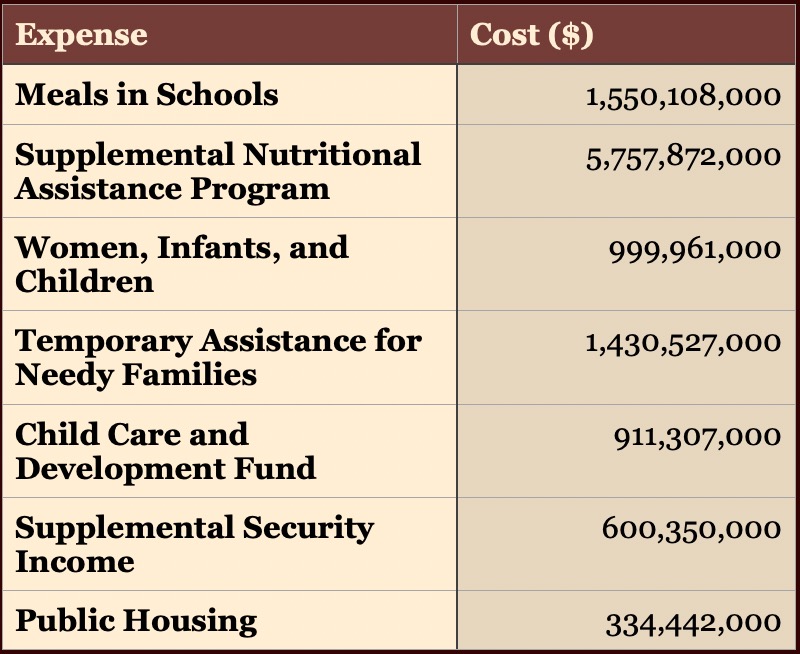
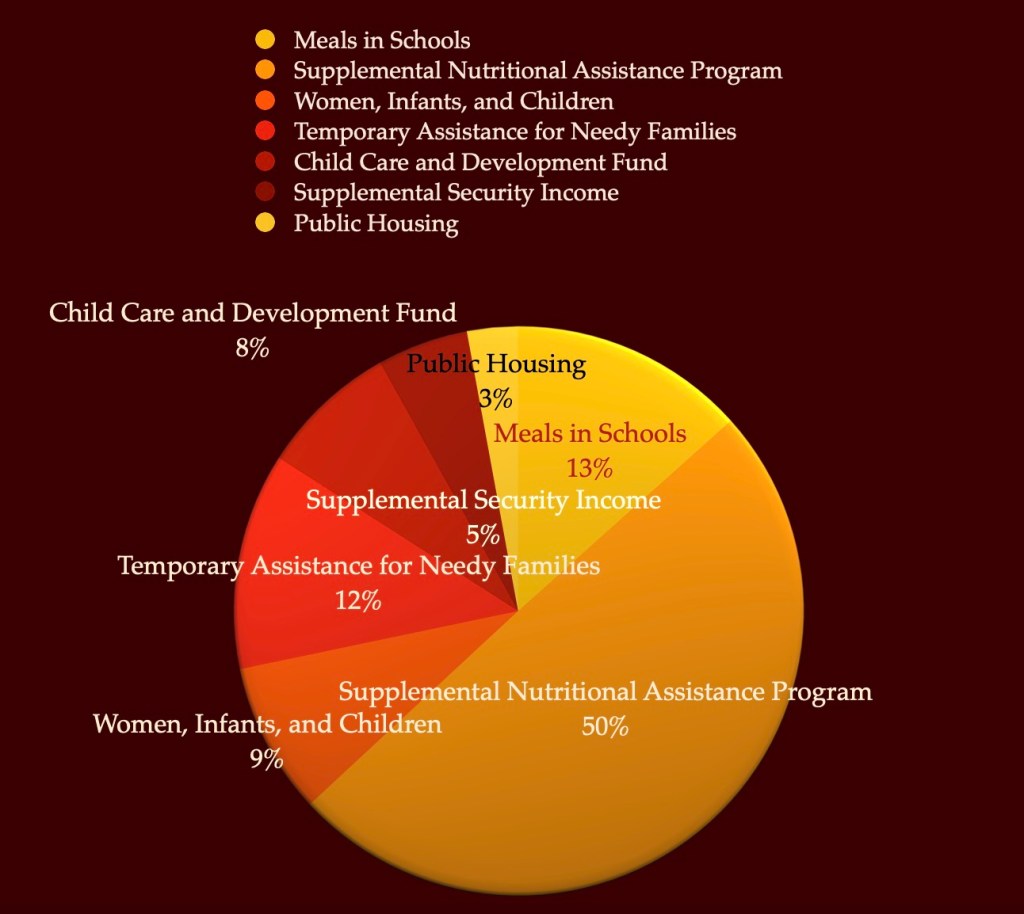
The Fair Report estimates that in fiscal year 2022, nearly $11.6 billion was spent by the federal government aiding undocumented immigrant families through such programs. The breakdown of these federal expenditures is shown in Exhibit 6 below.
The largest cost categories are the federal school meal programs and the Supplemental Nutritional Assistance (SNAP) Program, commonly referred to as “food stamps”. An estimated 2.1 million children of illegal aliens were eligible for SNAP as of 2022, with an average monthly federal expenditure per participant of about $230, leading to FAIR’s estimate of $5.8 billion total expenditure.
States contribute a share of the costs for some of these programs, with the state contribution estimated by FAIR total about $2 billion in fiscal year 2022. In addition to that, cities and towns have had to allocate huge sums of money on migrant shelters, hotels, gyms, and other facilities to house migrants, with the House Committe report offering numerous examples.13 In Chicago, $20 million per month is being spent towards housing aliens, worsening the city’s budget deficit. El Paso has been spending $300,000 a day, 20% of its budget. Washington, D.C. reportedly has run out of hotel space on account of rooms allocated to migrants. Maine, over a thousand miles from the border, has seen a historic influx of migrants that has overwhelmed local budgets and housing capacities.
New York City signed a $275 million contract with the Hotel Association of New York in early 2023 to house 5,000 individuals–a cost of $55,000 per person. According to the House Committee report, by August 2023 more than 57,000 illegal aliens were present in the city, with Mayor Adams reporting that the costs of sheltering this population were exceeding $9.8 million per day. This daily expenditure, equivalent to around $3.6 billion per year, reportedly surpassed the combined budgets of several New York City departments, and exceeded the entire budget of Dallas, Texas. In March 2023, the city submitted a request to the Federal Emergency Management Agency for reimbursement of $650 million dollars to help offset these costs.
Individual localities bear a variety of other additional significant costs of assisting migrants. For example, after illegal aliens were sent from New York City to Rochester County, New York, the city of Orangetown spent an additional $1 million to help food banks restock their shelves. 14
Exhibit 6: Alien Welfare Expense Breakdown
Source: FAIR 2023 report
Damage to Private Property along the Border
On top of the costs imposed on taxpayers by the migrant influx, the mass migration along the southwest border has taken a toll on private property and the environment. The number of incidents, the amount of damage or losses, and the cost of those damages only increase with the number of crossings.
As narrated by officials and citizens who’ve testified before Congress and summarized in the House Committee report, damage and devastation to private property and crops has posed challenges to farmers and ranchers in the border area.15 For instance, one South Texas rancher claimed that he’d spent up to $40,000 on property repairs. Another testified to $100,000 in property damage, including cars driving through fences. A fifth-generation rancher in Arivaca, Arizona, testified to bearing $60,000 in property repair costs per year and a $1 million loss in property value.
The sheriff of Kinney County, Texas, testified that “migrants had damaged or broke into houses, torn down fences, and left loads of trash on property in his county–and some owners have stopped rebuilding their fences”. The sheriff Yuma County, Arizona testified that the county has had to invest tens of dollars installing portable restrooms in agricultural fields to help prevent human waste damage to crops.16 Farmers in Yuma County, Arizona have sustained “staggering” amounts of crop damage and loss, forcing them to invest large sums in fencing and security.
Farming advocacy organization have also spoken out. In a letter to Department of Homeland Security Secretary Mayorkas, the American Farm Bureau Federation and the farm bureaus of all 50 states and Puerto Rico wrote, “Farm and ranch families, many of whom have owned land for generations, are bearing the brunt of this unprecedented influx and have border never seen a more dire situation.” The harm inflicted by migrants on the region’s agricultural has national repercussions, as the region is a major supplier of leafy green produce throughout North America through much of the year. 17
As noted in the House Committee report, fire damage is spreading, with migrants sometimes intentionally set fires in order to be noticed by border patrol to indicate they are lost. Migrants often break water lines to get access to drinking water and leave behind trash that can be digested by animals, leading to further losses. Property owners also fear ticks and illnesses like cattle fever that are brought by the crossers. Escaped, lost, and dispersed livestock is another common significant harm.
These scenes only scratch the surface of the unfortunate reality of the overlooked livelihoods of disheartened southwestern farmers and ranchers, who are an integral part of their regional economy and have national ramifications for food supply.
Costs of Transporting Migrants
The Biden administration has footed the bill to transport aliens from entry points to localities across the country, a cost ultimately borne by taxpayers. The administration ramped up operations to transport migrants by contracting these out to private firms or non-governmental entities. The costs of these operations stand apart from transport costs incurred directly by ICE and other law enforcement agencies, which are already accounted for in the law enforcement expenditure amounts cited previously.
In particular, in 2021 the federal government expanded its relationship with a private security and intelligence firm, MVM Inc., to transport family units and unaccompanied minors, doubling the size of its contract to $128 million. By September 2023, the cost for these services had accrued to $660 million.18
Border states themselves have shouldered much additional burden to transport migrants to the interior, which they have opted to do to ease the crisis situations they face. For instance, as documented in the House Committee report: 19
Between April 2022 and October 2023, the state of Texas sent more than 51,800 illegal aliens to major cities around the country, including Washington, Chicago, New York and Philadelphia, costing upwards of $75 million for bus companies.
In Arizona, from May-August 2022, 43 buses departed from the state to Washington, D.C., bringing 1,600 aliens to the east coast. Each bus cost around $83,000, bringing the total to about $35 million.
Then, in Florida, $12 million has been allocated by the Florida Department of Transportation to combat the Biden administration’s sending of migrants to the state.
The Takeaway – The Prioritization of Illegal Immigrants above Citizens
Also important to consider, alongside taxpayer borne government expenditures, are unreimbursed costs borne by institutions such as schools and hospitals, and indirect costs borne by private citizens. The latter often takes the form of resources and services diverted to benefit undocumented immigrants.
As aforementioned, likely only half of aliens are insured, so that aliens rely on emergency care providers, whose costs are transferred to the American taxpayer. But this also leads to the unsurprising fact that illegal immigrants have been flooding and filling hospitals, including emergency rooms, in border states.
Also as aforementioned, illegal aliens, and children thereof, are taking up space and straining capacity in American school districts. This often results in crowded classrooms and resources diverted to meeting the need for educating non-English speaking pupils. Financial support and scholarships that would otherwise have gone to citizens or permanent residents are now being handed to children of undocumented immigrants.
Numerous examples of such are documented in the House Committee report.20 One doctor from Yuma, Arizona, has testified that the skyrocketing number of migrants coming to his hospital is a major strain on hospital capacity, often requiring triple the usual quantity of human resources “to resolve their cases and provide them with a safe discharge.” One San Diego, California hospital described having to pay $1.5 million more in 2021 than in the previous year solely due to care provided to aliens.
Residents of Chicago’s South Shore pushed back against the city’s plan to house aliens including in a local K-mart supermarket and former high school, according to the House Committee Report. These testimonies also illustrate how the growing presence of migrants disproportionately affects minority communities in many cities. One South Shore resident quoted in that report decried how police resources were being diverted from high-crime neighborhoods:
“We’ve had a problem with police response in our neighborhood in the past, so to bring someone in, say they’re going to have police presence for 24 hours a day, does a couple of things. First of all, it’s slap in the face to those of us who have not had a police presence when we needed it. Secondly, it provides a resource to someone who does not pay taxes in our community when we have been starving for those resources ourselves.” 21
The situation with fentanyl and other substances trafficked across the southern border also comes into play in considering the costs to taxpayers of an unsecured border and would be remiss not to mention. The opioid epidemic, which has taken millions of lives nationwide in the last decade, including hundreds of thousands in the last four years, cost the taxpayer a whopping $1.5 trillion in 2020, a 35% increase from three years prior, in expenses such as medical and law enforcement expenses. 22 States, and obviously not just border states, bear devastating costs for this situation, in terms of both healthcare and law enforcement.23
The migrant crisis has disadvantaged ordinary citizens in small ways as well as large. For instance, in the Boston area in October 2023, “scores of military veterans, service academy graduates and families are scrambling to find hotel rooms” for the annual Army-Navy football game after one hotel management company effectively canceled reservations for at least 70 rooms at three hotels to house aliens instead. 24
Homeless citizens have been perhaps the most unfortunate indirect victims of the migrant crisis. The number of homeless Americans jumped a record 11% during 2022 to 557,000 people due to rising housing costs, and they must compete for limited shelter space with illegal aliens.25 The Biden administration apparently has created situations where needy veterans live on the streets while aliens are housed on the dime of the taxpayer.
In August 2023, the administration requested $600 million from Congress to appropriate to FEMA’s Shelter Services Program.26 Rather than enforce border laws and care for homeless Americans, the Biden administration accomplished the opposite–enabling illegal migrants to stay in the country and diverting resources for sheltering the homeless.
Beyond these various indirect costs, one should also factor in the effect of millions of undocumented immigrants added to labor and housing markets. Basic economics implies that this influx depresses hourly wages for low- and moderate-income citizens while driving up their housing costs.
The surge potentially also ushers in a shift in interior demography that is disruptive to the electoral process. For instance, Census counts used to allocate seats in the U.S. House of Representatives do not distinguish alien residents from the total population of each House district.
As the plaintiffs in Texas v. Department of Homeland Security stated in their 2023 complaint against the Biden Administration’s proposed alien parole program, the administration’s policies have caused “substantial, irreparable harms.”27 These policies have placed many states and localities in untenable situations, enabling “potentially hundreds of thousands of additional aliens to enter each of their already overwhelmed territories.”
The current immigration has severely stressed public and private resources originally intended for the benefit of the citizen. American citizens, as it stands now, are paying out of their own wallets, directly or indirectly, for a subversion of the nation’s sovereignty imposed on them by their own government. Our border must be repaired if our nation is to best protect the safety of its citizens and provide adequate resources to meet their economic and social needs. The longer the influx continues unabated, the greater the cost to the average American taxpayer and the greater the corrosion to the sovereignty of the nation as a whole. We must end it in the name of God.
See “Costliest U.S. Tropical Cyclones.” National Centers for Environmental Information, November 1, 2024. Note that the cost estimates in that study are in 2024 dollars, and therefore are inflated relative to the dollar estimates in the FAIR report. ↩︎
Accessed 10/14/2024. States and territories without a complete time series of cost information (VI, VT, TN, PR, PA, NE, MS, MI, MN, ME, KS, IN, CT, CO, AR, and AK) are excluded from the calculations. ↩︎
U.S. Congress, The Joint Economic Committee, Democrats, The Economic Toll of the Opioid Crisis Reached Nearly $1.5 Trillion in 2020, 117th Cong., 2nd sess., September 28, 2022, ↩︎
See pages 11-15 of the House Committee report for further discussion of the impact of the fentanyl crisis on American citizens. ↩︎
Americans now view immigration as a key issue in the 2024 election, as the current administration’s policies have allowed so many persons to cross the border unvetted. Many American citizens are concerned that this places them at risk personally or adversely affects them financially.
One might have read or seen plenty of news stories about the huge influx of migrants into our country during the past few years, associated with human trafficking and an increase in the flow of dangerous substances like fentanyl. There have also been many stories about violent crimes committed by illegal border crossers.
What one may not have seen is a quantitative presentation of the facts–the official data analyzed and put into historical perspective in a concise and unified way. The goal of this report is to provide just that–a basic, quantitative analysis characterizing the crisis. Unless otherwise noted, the source of these data is the U.S. Department of Homeland Security.
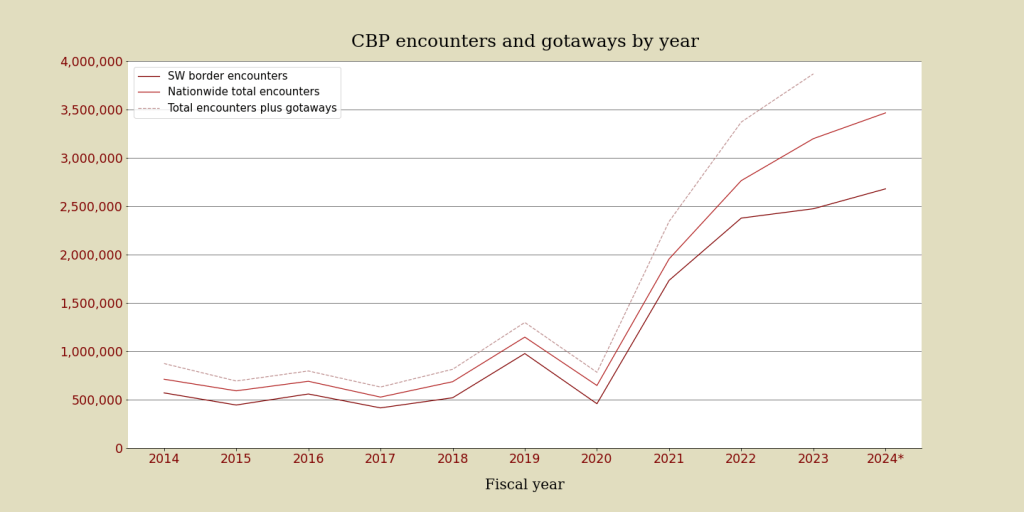
The chart below shows total Customs and Border Patrol encountersby fiscal year for 2014 through 2024, both for the Southwest border and nationwide, where an encounter can be either of an individual or a family unit. (For 2024 the chart shows an extrapolated annual count obtained by doubling the October 2023 through March 2024 total.) In addition, the chart depicts the total of encounters plus gotaways, where annual counts of the latter through fiscal year 2023 are based on official data obtained and reported by Fox News. Whereas encounters encompass border crossers who are apprehended, gotaways refer to those spotted by agents or by video surveillance but not apprehended.
A chart showing encounters and gotaways by year since 2014, showing total encounters both at the border and nationwide, plus estimated gotaways. *2024 is an annualized count.
The most striking takeaway from this chart is the huge acceleration in migrant encounters and gotaways after 2020, accompanying the switch to the Biden administration. By 2022, the annual volume of Southwest border encounters had almost quintupled relative to 2020, from about half-a-million family units or individuals to nearly two and a half million. Annual volume continued to rise after 2022, though less steeply.
In contrast, across the transition from Obama to Trump, little difference is seen. The annual rate of border encounters dropped slightly between the last three years of Obama into the first two years of Trump due to enforcement.
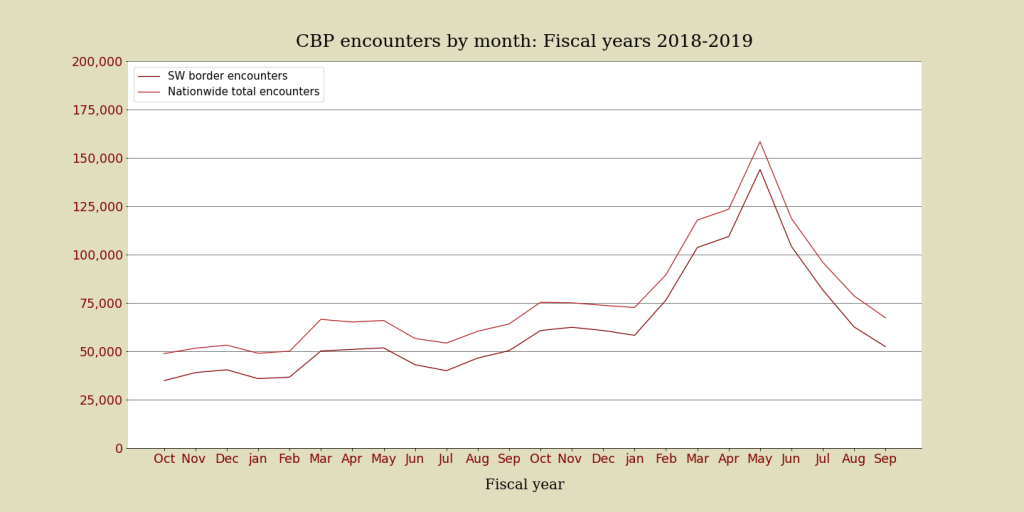
A spike occurred during 2019 when, at least in part due to a worsening gang violence and crime situation in Central America, caravans of migrants seeking asylum in the United States surged the border. This was quickly curbed by the Trump administration, as seen in the monthly data on volume of encounters during 2018 and 2019, shown below.
A chart showing the spike in border encounters in fiscal year 2019, managed by the administration through pressure on the Mexican government.
The chart indicates that the spike occurred between February and July of 2019 and that by September the volume of border crossers had returned to its 2018 level.
This was accomplished primarily through pressure (threat of tariffs) on the Mexican government to apply a 2018 agreement (so-called “remain in Mexico”) on treatment of asylum seekers. According to these protocols, non-Mexican migrants traversing Mexico seeking asylum in the U.S. were to be kept from crossing into the U.S. while their asylum cases were still pending.
In the final three months of the Trump administration, total encounters at the Southwest border hovered at record lows of slightly above 70,000 each month. After Joe Biden assumed the presidency, the number quickly soared, reaching over 200,000 as of July 2021.
In December 2023, over 300,000 individuals or family units were caught trying to cross the border, a historical record. As of March 2024, total encounters under the current administration had neared 10 million, as well as ~1.6 million gotaways who are presently in an unknown location.
Demographic Composition of SW Border Encounters
A graph indicating the distribution of family status by individual adults (dark red), family units (yellow), and unaccompanied minors (lighter red). Although the percentage of unaccompanied minors is declining, the actual number has increased dramatically since before 2021.
The chart above summarizes how the demographic composition of encountered individuals and families has evolved over the years. Specifically, the chart shows the distribution across three migrant categories: family units, single adults, and unaccompanied minors.
The proportion of unaccompanied minors has steadily declined from 13 percent in 2014 to 5 percent as of 2024; however, the overall migrant surge under the current administration brought a staggering increase in the sheer number of unaccompanied minors crossing the border. For instance, in 2022 there were around 150,000 unaccompanied minor encounters, more than two and a half times the average annual count during 2014 through 2020. This is extremely concerning, for obvious reasons.
The mix of single adults versus family units has fluctuated through the years. Except during the 2019 spike, a majority of SW border encounters have been single adults. In 2023 and 2024, family units have comprised more than 35 percent of encounters, a larger share than in any prior year other than 2019.
Post-Encounter Outcomes: Expulsion, Release, or Transfer to ICE
The surging number of CBP encounters only half describes the border situation. The other half would be the fate of these apprehended migrants. Under the Biden administration, deportations and expulsions dropped sharply while releases into the U.S. soared.
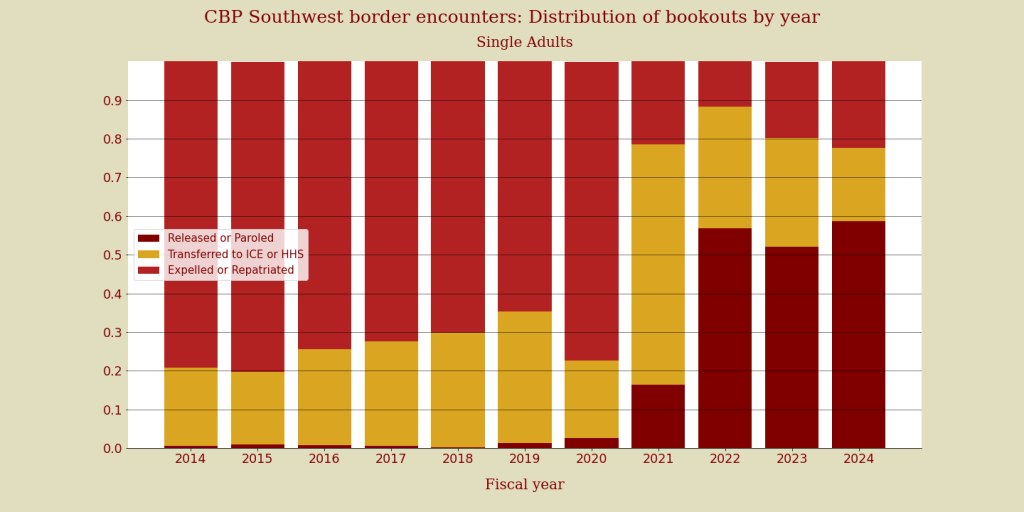
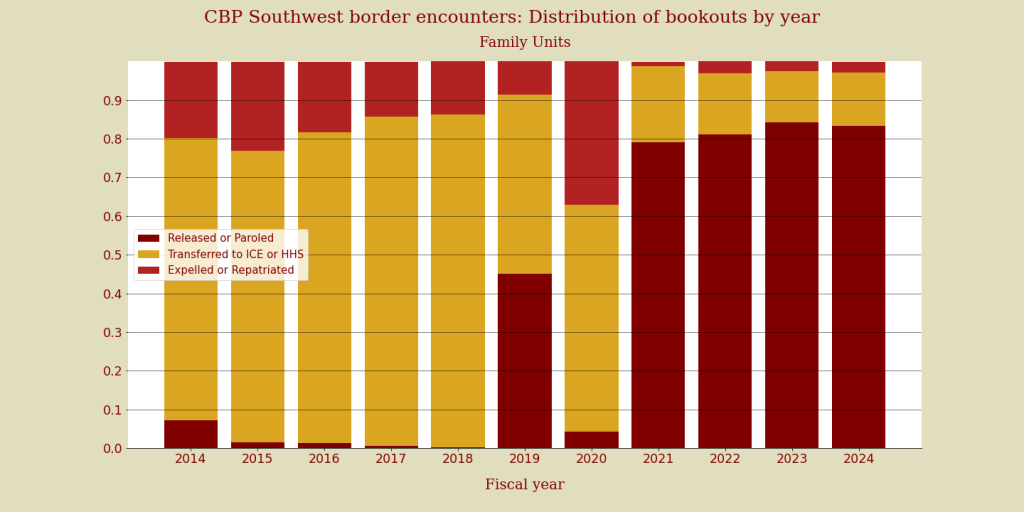
Distributions, by family status, of Southwest border encounters across three outcome categories–expulsion or repatriation; transfer to Immigration and Customs Enforcement (for further evaluation and processing); and release into the U.S. (a parole or a release on their own recognizance)–are shown below.
A chart showing migrant CBP bookout status by year for single adults. Note the sharp drop in expulsions and increase in releases under the Biden administration.
This chart shows CBP bookout status by year for family units. Notice the change in proportions of those transferred to ICE after 2020.
Through fiscal year 2020, most single adults apprehended by CBP were expelled or deported, and nearly all of the rest were transferred to ICE custody for further processing. Very few were paroled or otherwise directly released into the U.S. In this regard, there wasn’t much difference in treatment of migrants between the Obama and Trump administrations.
After 2020, that situation changed dramatically. From 2022 on, more than half of individual adult detainees were released by CBP, while only about 10 to 20 percent have been expelled or deported.
In regard to family units, prior to 2021 a much larger proportion were transferred to ICE facilities and relatively few family units were simply expelled or deported compared to individual adults. During the migrant spike in fiscal year 2019, about half of family units were released, but the share reverted to close to zero when the surge eased in 2020. Again, with the exception of 2019, there wasn’t much difference between the Obama and Trump administrations.
Under the Biden administration, 80 percent or more of family units have been released. This lenient policy may have encouraged more migration by family units, which may explain the increase since 2022 in the share of migrants arriving in claimed family groups (which aren’t necessarily always actual families.)
These facts indicate that the Biden administration has not curbed illegal immigration in any serious manner, but instead has sought to integrate as many of these migrants as possible into American society. In doing so, the administration has seemingly ignored the potential costs to American citizens. These include both the direct costs of absorbing the migrants, indirect costs such as upward pressure on rents and house prices and downward pressure on wages for lower-income American households, and crime tied to inadequate vetting of migrants.
The Countries-of-Origin of the Migrants
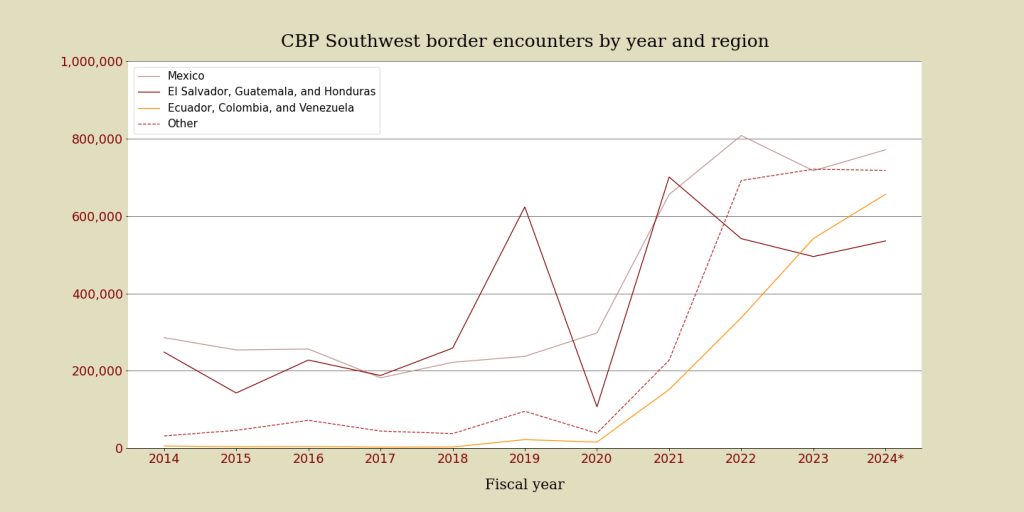
Another dramatic change occurring after Biden took office has been the much wider range of nationalities of individuals and families arriving at the border. The chart below shows trend in number of encounters at the Southwest border by region of origin of the individual or family unit.
A graph showing the number of border encounters by region over the last ten years: Mexico and Central America have been historically the main source; migration from Colombia, Ecuador, and Venezuela and other countries worldwide has grown rapidly since 2021. *2024 is an annualized count.
Until 2021, nearly all encounters at the Southwest border were of migrants from Mexico and Central America. Under the current administration, there has been a dramatic rise in migrants from other countries throughout Latin American, the Caribbean, and from other parts of the world as well, as seen prominently in the chart.
Especially since 2022, the migrants coming to the Southwest border have comprised a mix of many different nationalities. There have been thousands of encounters of migrants from countries as wide ranging as China, India, Mauritania, Nepal, Senegal, and Turkey. For example, in 2023 there were about 24,000 encounters of migrants from China, about double the entire 2014 through 2022 count.
The Biden Administration’s Encouragement of the Border Surge
Is it mere coincidence, or as sometimes claimed a consequence of Trump administration policies, that migrant crossings surged as soon as the Biden administration took office? Such an assessment lacks credibility.
Multiple actions and words of President Biden, even from the time he was a candidate and during the early weeks of his administration can be pointed to as helping to promote the surge. When then-candidate Biden was asked about his immigration policy, he said he would “surge to the border” those seeking asylum. As a campaign promise, he vowed to stop building the border wall. Upon his taking office, an entire series of repeal and loosening of border policies and enforcement ensued.
Immediately upon assuming the presidency, for example, President Biden abandoned President Trump’s “remain in Mexico” program and repealed Trump’s near-total ban on entry from specific high-risk countries such as Iraq and Syria. The Biden administration then drastically loosened the Trump-era standards of who is subject to deportation or arrest. The requirements for immigrant green cards or visas, temporary protected status, and government benefits were also loosened. The practice of “catch and release”, whereby large numbers of detained aliens were unconditionally released to await an administrative hearing was normalized. (For additional details, see here, here, and here.)
Undoubtedly, the Biden administration’s lax enforcement at the border has operated as a kind of feedback loop. Lax border policy encourages successively more migration, which in turn further overwhelms existing enforcement resources, which encourages yet more migration.
One consequence of this laxity is that numerous individuals from terror hotbeds in the Middle East have been apprehended at the border and even within the interior. These include 160 persons on the terror watchlist who were apprehended along the border in 2023, up from 100 in 2022. There is also credible circumstantial evidence that Venezuela’s government has taken advantage of the situation by releasing prisoners en masse and encouraging them to head to the U.S.
Perhaps the current administration has been motivated by a short-sighted, knee-jerk compassion for poor citizens of other countries. Perhaps, it has been driven by political considerations. Either way, there can be little doubt that the administration’s open border policies have compromised the sovereignty and safety of the American people.




 Unrivaled Politics