
The Broken Border Quantified
Americans now view immigration as a key issue in the 2024 election, as the current administration’s policies have allowed so many persons to cross the border unvetted. Many American citizens are concerned that this places them at risk personally or adversely affects them financially.
One might have read or seen plenty of news stories about the huge influx of migrants into our country during the past few years, associated with human trafficking and an increase in the flow of dangerous substances like fentanyl. There have also been many stories about violent crimes committed by illegal border crossers.
What one may not have seen is a quantitative presentation of the facts–the official data analyzed and put into historical perspective in a concise and unified way. The goal of this report is to provide just that–a basic, quantitative analysis characterizing the crisis. Unless otherwise noted, the source of these data is the U.S. Department of Homeland Security.
The chart below shows total Customs and Border Patrol encounters by fiscal year for 2014 through 2024, both for the Southwest border and nationwide, where an encounter can be either of an individual or a family unit. (For 2024 the chart shows an extrapolated annual count obtained by doubling the October 2023 through March 2024 total.) In addition, the chart depicts the total of encounters plus gotaways, where annual counts of the latter through fiscal year 2023 are based on official data obtained and reported by Fox News. Whereas encounters encompass border crossers who are apprehended, gotaways refer to those spotted by agents or by video surveillance but not apprehended.
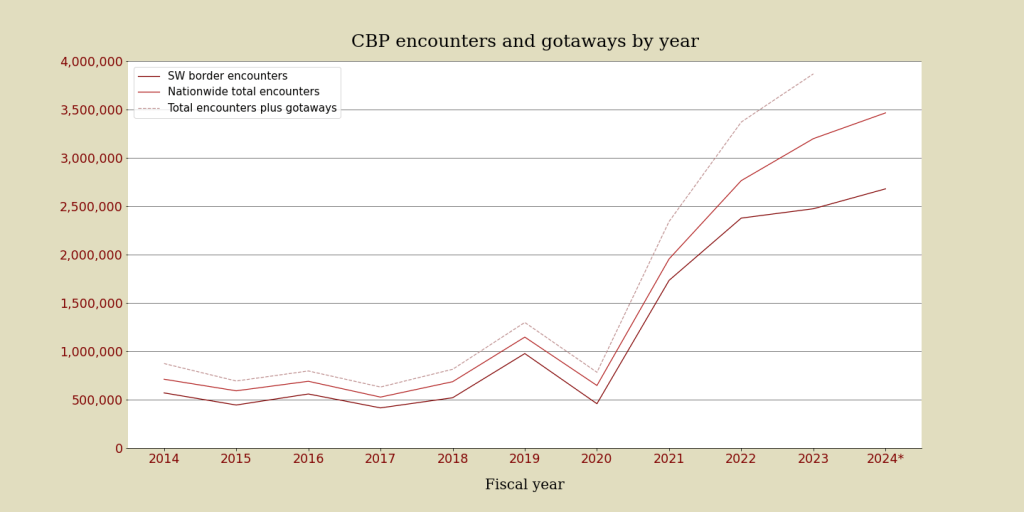
The most striking takeaway from this chart is the huge acceleration in migrant encounters and gotaways after 2020, accompanying the switch to the Biden administration. By 2022, the annual volume of Southwest border encounters had almost quintupled relative to 2020, from about half-a-million family units or individuals to nearly two and a half million. Annual volume continued to rise after 2022, though less steeply.
In contrast, across the transition from Obama to Trump, little difference is seen. The annual rate of border encounters dropped slightly between the last three years of Obama into the first two years of Trump due to enforcement.
A spike occurred during 2019 when, at least in part due to a worsening gang violence and crime situation in Central America, caravans of migrants seeking asylum in the United States surged the border. This was quickly curbed by the Trump administration, as seen in the monthly data on volume of encounters during 2018 and 2019, shown below.
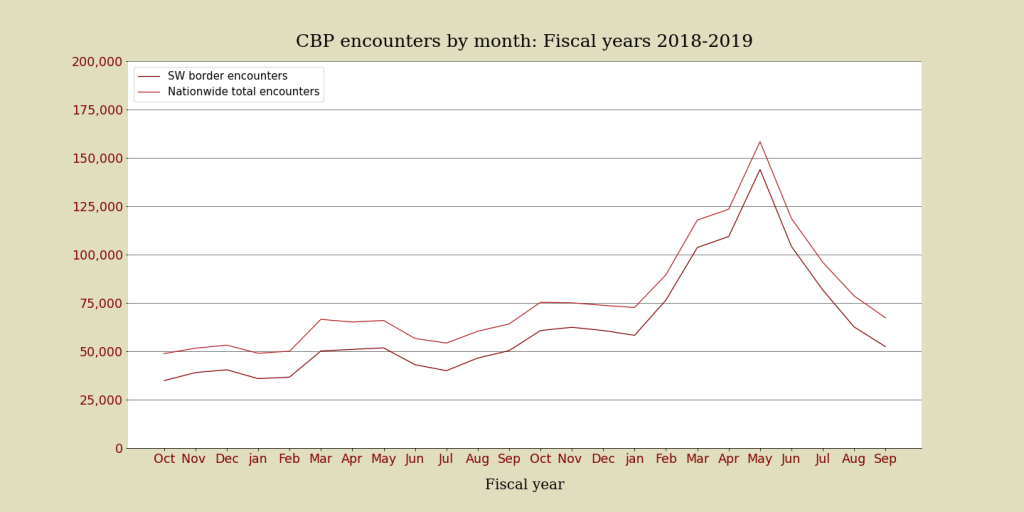
The chart indicates that the spike occurred between February and July of 2019 and that by September the volume of border crossers had returned to its 2018 level.
This was accomplished primarily through pressure (threat of tariffs) on the Mexican government to apply a 2018 agreement (so-called “remain in Mexico”) on treatment of asylum seekers. According to these protocols, non-Mexican migrants traversing Mexico seeking asylum in the U.S. were to be kept from crossing into the U.S. while their asylum cases were still pending.
In the final three months of the Trump administration, total encounters at the Southwest border hovered at record lows of slightly above 70,000 each month. After Joe Biden assumed the presidency, the number quickly soared, reaching over 200,000 as of July 2021.
In December 2023, over 300,000 individuals or family units were caught trying to cross the border, a historical record. As of March 2024, total encounters under the current administration had neared 10 million, as well as ~1.6 million gotaways who are presently in an unknown location.
Demographic Composition of SW Border Encounters

The chart above summarizes how the demographic composition of encountered individuals and families has evolved over the years. Specifically, the chart shows the distribution across three migrant categories: family units, single adults, and unaccompanied minors.
The proportion of unaccompanied minors has steadily declined from 13 percent in 2014 to 5 percent as of 2024; however, the overall migrant surge under the current administration brought a staggering increase in the sheer number of unaccompanied minors crossing the border. For instance, in 2022 there were around 150,000 unaccompanied minor encounters, more than two and a half times the average annual count during 2014 through 2020. This is extremely concerning, for obvious reasons.
The mix of single adults versus family units has fluctuated through the years. Except during the 2019 spike, a majority of SW border encounters have been single adults. In 2023 and 2024, family units have comprised more than 35 percent of encounters, a larger share than in any prior year other than 2019.
Post-Encounter Outcomes: Expulsion, Release, or Transfer to ICE
The surging number of CBP encounters only half describes the border situation. The other half would be the fate of these apprehended migrants. Under the Biden administration, deportations and expulsions dropped sharply while releases into the U.S. soared.
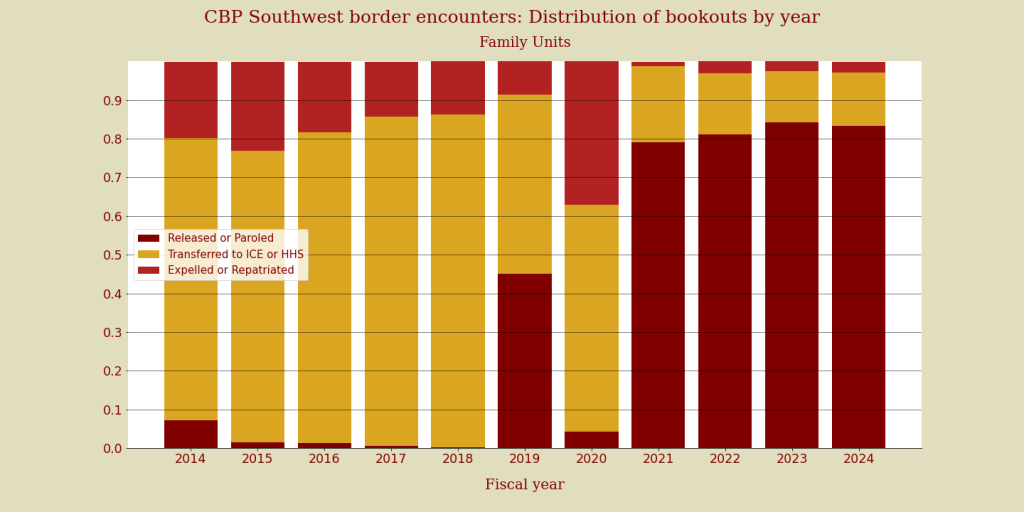
Distributions, by family status, of Southwest border encounters across three outcome categories–expulsion or repatriation; transfer to Immigration and Customs Enforcement (for further evaluation and processing); and release into the U.S. (a parole or a release on their own recognizance)–are shown below.
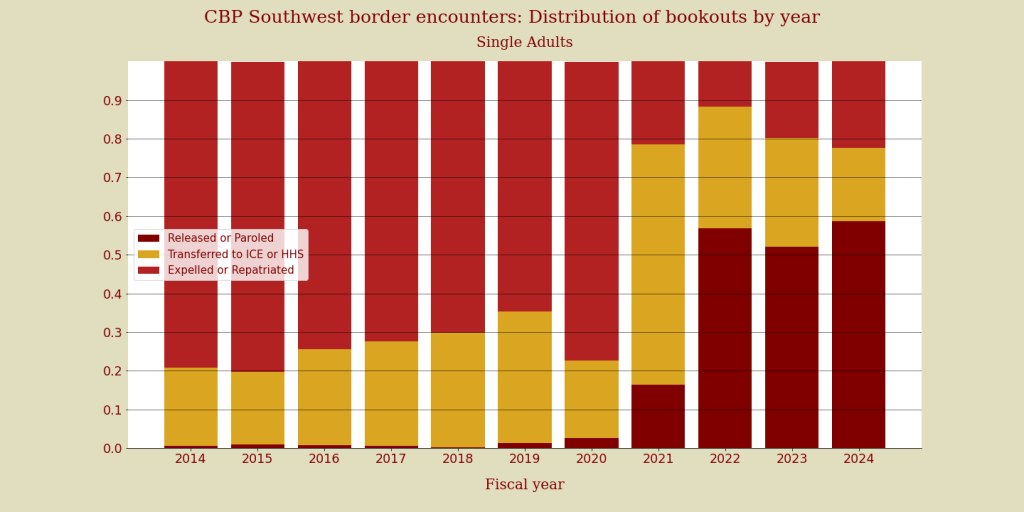
Through fiscal year 2020, most single adults apprehended by CBP were expelled or deported, and nearly all of the rest were transferred to ICE custody for further processing. Very few were paroled or otherwise directly released into the U.S. In this regard, there wasn’t much difference in treatment of migrants between the Obama and Trump administrations.
After 2020, that situation changed dramatically. From 2022 on, more than half of individual adult detainees were released by CBP, while only about 10 to 20 percent have been expelled or deported.
In regard to family units, prior to 2021 a much larger proportion were transferred to ICE facilities and relatively few family units were simply expelled or deported compared to individual adults. During the migrant spike in fiscal year 2019, about half of family units were released, but the share reverted to close to zero when the surge eased in 2020. Again, with the exception of 2019, there wasn’t much difference between the Obama and Trump administrations.
Under the Biden administration, 80 percent or more of family units have been released. This lenient policy may have encouraged more migration by family units, which may explain the increase since 2022 in the share of migrants arriving in claimed family groups (which aren’t necessarily always actual families.)
These facts indicate that the Biden administration has not curbed illegal immigration in any serious manner, but instead has sought to integrate as many of these migrants as possible into American society. In doing so, the administration has seemingly ignored the potential costs to American citizens. These include both the direct costs of absorbing the migrants, indirect costs such as upward pressure on rents and house prices and downward pressure on wages for lower-income American households, and crime tied to inadequate vetting of migrants.
The Countries-of-Origin of the Migrants
Another dramatic change occurring after Biden took office has been the much wider range of nationalities of individuals and families arriving at the border. The chart below shows trend in number of encounters at the Southwest border by region of origin of the individual or family unit.
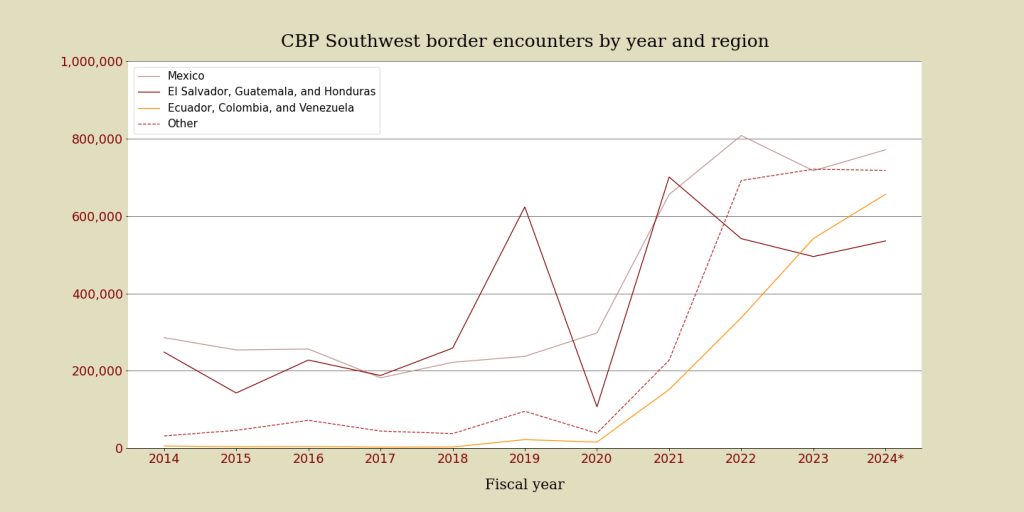
Until 2021, nearly all encounters at the Southwest border were of migrants from Mexico and Central America. Under the current administration, there has been a dramatic rise in migrants from other countries throughout Latin American, the Caribbean, and from other parts of the world as well, as seen prominently in the chart.
Especially since 2022, the migrants coming to the Southwest border have comprised a mix of many different nationalities. There have been thousands of encounters of migrants from countries as wide ranging as China, India, Mauritania, Nepal, Senegal, and Turkey. For example, in 2023 there were about 24,000 encounters of migrants from China, about double the entire 2014 through 2022 count.
The Biden Administration’s Encouragement of the Border Surge
Is it mere coincidence, or as sometimes claimed a consequence of Trump administration policies, that migrant crossings surged as soon as the Biden administration took office? Such an assessment lacks credibility.
Multiple actions and words of President Biden, even from the time he was a candidate and during the early weeks of his administration can be pointed to as helping to promote the surge. When then-candidate Biden was asked about his immigration policy, he said he would “surge to the border” those seeking asylum. As a campaign promise, he vowed to stop building the border wall. Upon his taking office, an entire series of repeal and loosening of border policies and enforcement ensued.
Immediately upon assuming the presidency, for example, President Biden abandoned President Trump’s “remain in Mexico” program and repealed Trump’s near-total ban on entry from specific high-risk countries such as Iraq and Syria. The Biden administration then drastically loosened the Trump-era standards of who is subject to deportation or arrest. The requirements for immigrant green cards or visas, temporary protected status, and government benefits were also loosened. The practice of “catch and release”, whereby large numbers of detained aliens were unconditionally released to await an administrative hearing was normalized. (For additional details, see here, here, and here.)
Undoubtedly, the Biden administration’s lax enforcement at the border has operated as a kind of feedback loop. Lax border policy encourages successively more migration, which in turn further overwhelms existing enforcement resources, which encourages yet more migration.
One consequence of this laxity is that numerous individuals from terror hotbeds in the Middle East have been apprehended at the border and even within the interior. These include 160 persons on the terror watchlist who were apprehended along the border in 2023, up from 100 in 2022. There is also credible circumstantial evidence that Venezuela’s government has taken advantage of the situation by releasing prisoners en masse and encouraging them to head to the U.S.
Perhaps the current administration has been motivated by a short-sighted, knee-jerk compassion for poor citizens of other countries. Perhaps, it has been driven by political considerations. Either way, there can be little doubt that the administration’s open border policies have compromised the sovereignty and safety of the American people.
 Unrivaled Politics
Leave a comment